
Biotech site leaders focus on wastewater and PFAS at NCLifeSci dinner
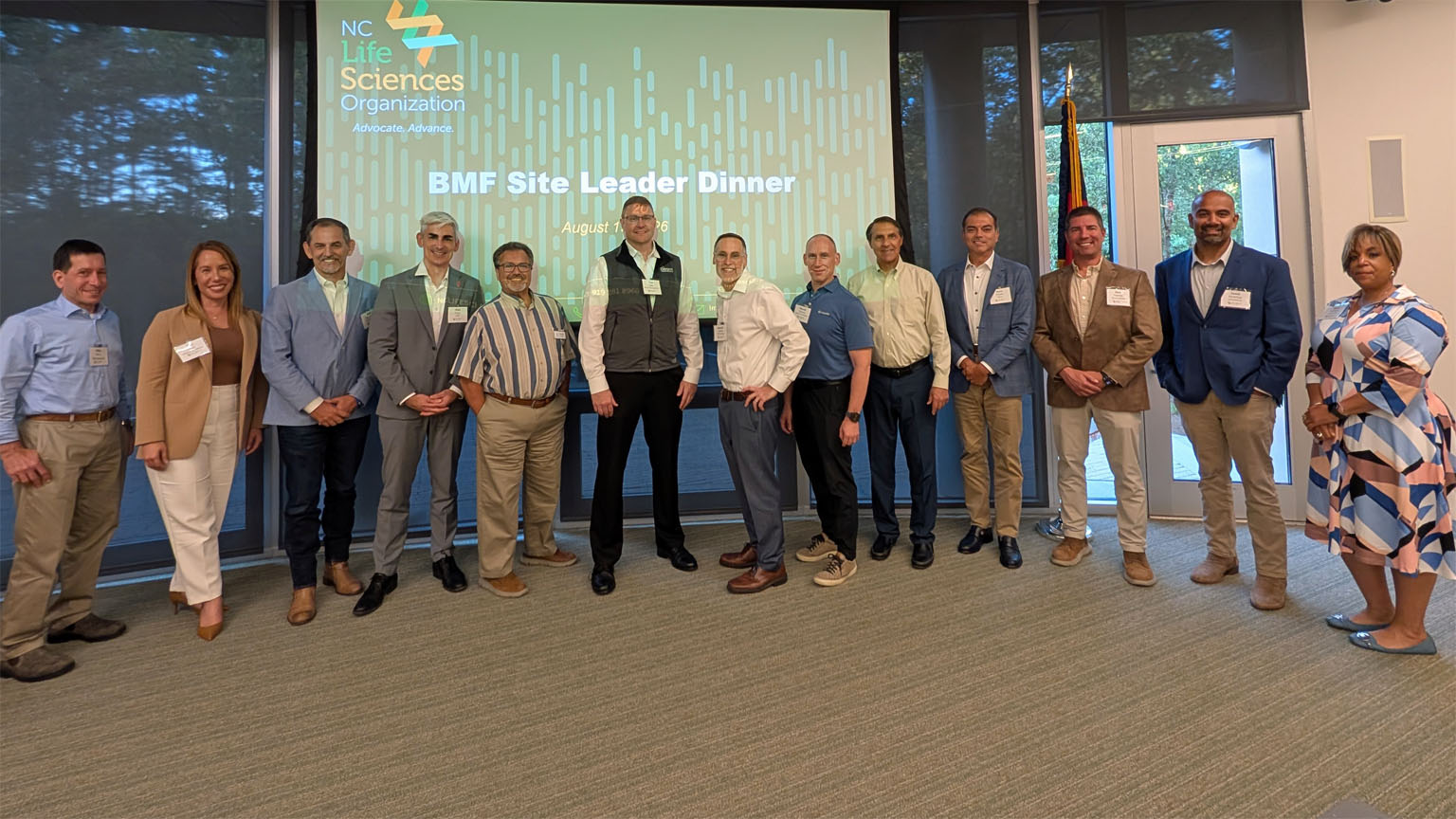
Site leaders from 13 biomanufacturing companies met Aug. 19 for the annual NCLifeSci Biotech Manufacturer's Forum Site Leader Dinner where a state environmental official named wastewater capacity as a leading infrastructure constraint for the industry in North Carolina.
The meeting and dinner ran from 5:20 to 7:20 p.m. and included networking, member introductions and a look ahead at forum topics for 2027. BMF Program Manager Bill Monteith opened the program and closed the evening. Jenae Williams, NCLifeSci director of workforce and partnerships, led the 2027 topics discussion.
Companies with leaders present included Amgen, Beam Therapeutics, CSL Seqirus, Eli Lilly, Genentech, Johnson & Johnson, Kyowa Kirin, Liquidia Technologies, Merck, Novonesis, Novo Nordisk and Pfizer.
David Payne, director of intergovernmental affairs and economic development at the NC Department of Environmental Quality, delivered the main presentation on water. Payne described DEQ as a partner to industry and urged companies to involve the department early in capital decisions. He said DEQ, the Economic Development Partnership of North Carolina and the Department of Commerce work together to support business growth.
Payne pointed to wastewater capacity, not water supply, as the primary statewide limit. He said other recruited industries, including defense contractors, critical minerals producers and advanced manufacturers, compete for the same capacity. For life sciences, he identified pretreatment as the most sensitive issue and cited nutrients, ammonia, salts, phosphorus and nitrogen beyond categorical limits. Payne listed plant upgrades, advanced filtration and membrane technology and regional treatment shared among facilities as potential solutions. He said one company might soon announce an industry-led reuse project.
On water supply, Payne said Triangle-area reservoirs have largely recovered, though not all sit at full pond. He said El Niño conditions point to a wetter fall and winter.
On PFAS, Payne said the Environmental Management Commission is debating changes to groundwater and surface water standards. He noted detectable PFOS or PFOA in groundwater already counts as a violation. He cited the Fayetteville Public Works Commission's 10-year capital plan for PFAS filtration, tied to Cape Fear River and Chemours legacy contamination.
Payne gave a mixed view on sustainability. He said renewable energy has lost priority in state and federal policy, while large corporations continue their own sustainability goals. He cited Jet Zero in Greensboro, which is building water reuse into the facility design.
Payne also highlighted DEQ's Environmental Stewardship Initiative, a no-cost technical assistance program on energy and water use, sustainable feedstock sourcing and recycling markets. Participants have saved more than 18 billion gallons of water, he said.
Williams closed the program with a poll and discussion on possible 2027 forum topics across workforce development, infrastructure and other areas.