
Panelists connect workplace mental health to culture, leadership and retention at DEI forum
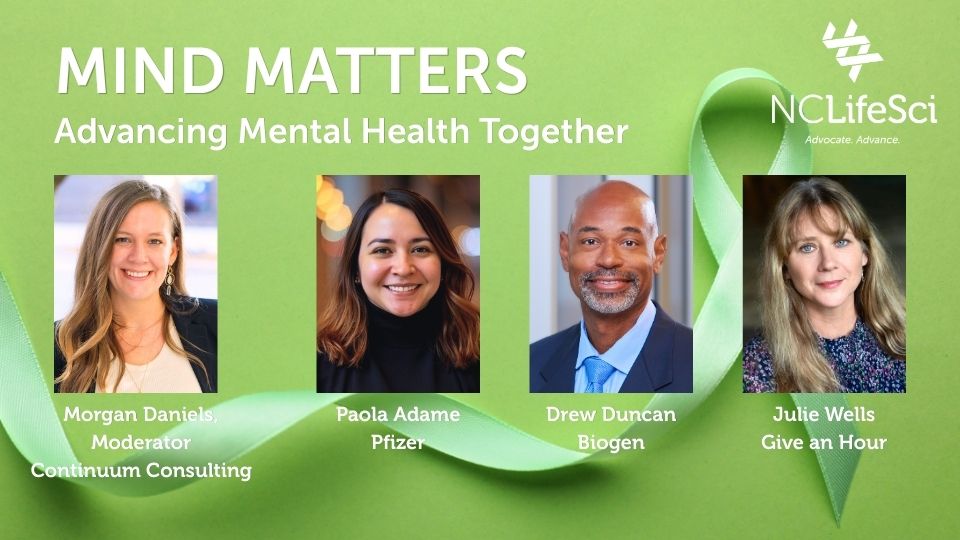
Workplace mental health depends less on any single program and more on culture, leadership and everyday connection, panelists said during the NCLifeSci DEI virtual forum, "Mind Matters: Advancing Mental Health Together," held online on Aug. 20.
Morgan Daniels, CEO of Continuum Consulting, moderated the panel and set the tone early. "One in five folks have a mental health illness, but five in five of us all have mental health," she said.
Panelists were
- Paola Adame, senior manager of business operations for Pfizer's Global Hospital and Biosimilars unit;
- Drew Duncan, global human resources lead at Biogen; and
- Julie Wells, strategic relationships director at Give an Hour.
Calhoun Coaching & Consulting sponsored the forum.
Peer support at Pfizer
Adame described a mental health ambassador program she helped build at Pfizer's Sanford site after the pandemic deepened isolation for many colleagues. The effort gathered volunteers from across departments and shifts and trained them in Mental Health First Aid, a certification she compared to CPR and standard first aid.
The training gave colleagues "a great entry point into feeling confident around having discussions related to mental health and mental health stressors," Adame said.
Team leads and several leaders took the training alongside frontline volunteers, a mix Adame called deliberate. Visible support from managers shows employees the organization stands behind its words, she noted. The volunteer network began working as a referral system: when a manager saw a colleague struggling, the manager pointed the person to a trained peer for a first conversation or help finding resources.
Adame kept the group active through quarterly meetings, published office hours, email signatures and a shared logo, plus recertification support. One colleague preferred to speak Spanish about a personal situation, and the network connected the person to Adame, who guided them to a community resource.
Expanding resources and steadying retention at Biogen
Duncan, who leads HR for more than 1,200 Biogen employees across the United States, Ireland and Switzerland, focused on resources and leadership behavior. Biogen expanded its employee assistance program, or EAP, to include career coaching for all employees rather than reserving coaching for high-potential staff.
"There's an extra resource that's confidential outside of the organization," Duncan said, describing coaching for career questions and manager relationships.
Biogen's leadership also issued extra wellness days after intense stretches of product launches and acquisitions, scheduling them so the whole company paused at once. A concierge service helps employees handle errands such as gifts, travel and car maintenance, reducing daily stress.
Duncan tied the approach to retention. Biogen's turnover has fallen below biotech industry benchmarks, which he put at roughly 12% to 18% depending on the segment. He credited clear communication about benefits, including benefits office hours, as one factor among several.
"You don't have to think well-being and performance are competing priorities," Duncan said. "You can have both."
A consultant's view on listening and personalization
Wells, whose organization works only on mental health, urged employers to move past programs alone. Mental health support has to be nuanced and personal, she said, and the strongest returns come from connection between people through formal or informal peer support.
She pressed employers to highlight EAPs rather than assume awareness. Give an Hour holds an annual EAP review and invites leaders to share how they have used the resource. Most companies offer an EAP as a safety mechanism, Wells said, yet the benefit stays underused.
Listening drives her assessments. Wells favors quarterly surveys and listening sessions split between leaders and other employees, a format designed to surface what people need versus what they receive. More than half of the workforce serves as caregivers in some capacity, she said, and life events will disrupt anyone.
Leadership sets the tone
All three panelists returned to leadership as the deciding factor. Duncan said managers add or remove stress and shape the employee experience, and he urged authentic check-ins.
"When you ask someone how they're doing, pause and actually mean it," he said.
Duncan pointed to psychological safety as a measured priority at Biogen. The company tracks the measure in its annual engagement survey and gives each leader of five or more employees an individual report, then trains leaders to build trust where scores lag.
Role modeling matters as much as measurement, he added. Duncan shares his own use of the EAP when he refers employees, so the referral comes from experience rather than a script.
Wells reinforced the point on presence. "'How are you doing?' is a greeting in our culture. It's not a question," she said, encouraging leaders to change their tone and dig past a reflexive "I'm fine."
Barriers, accountability and resources
The panelists named familiar obstacles: stigma around asking for help, competing deadlines and the need for middle-management buy-in. Adame split Pfizer's training across two days so participants had time to absorb the material, which required managers to free up staff in a 24-hour operation.
Wells raised the balance between accommodation and accountability. When someone steps back, the work shifts to teammates, so leaders have to discuss the tradeoff honestly to avoid friction. She also flagged the burnout risk leaders carry themselves, a group she described as high risk and often isolated.
Wells shared tools from Give an Hour, including Five Signs of Emotional Distress and a Seven Minutes to Support guide, plus resources on trauma-informed leadership and supervisor burnout. She noted people spend more than 90,000 hours of their lives at work, a figure she used to argue for normalizing these conversations.
Adame offered a closing frame. "Caring about employees as human is not a nice to have," she said. "It should be an essential resource."