
Forum: Outsource early, stay lean and plan for Phase 1, panelists tell biotech founders
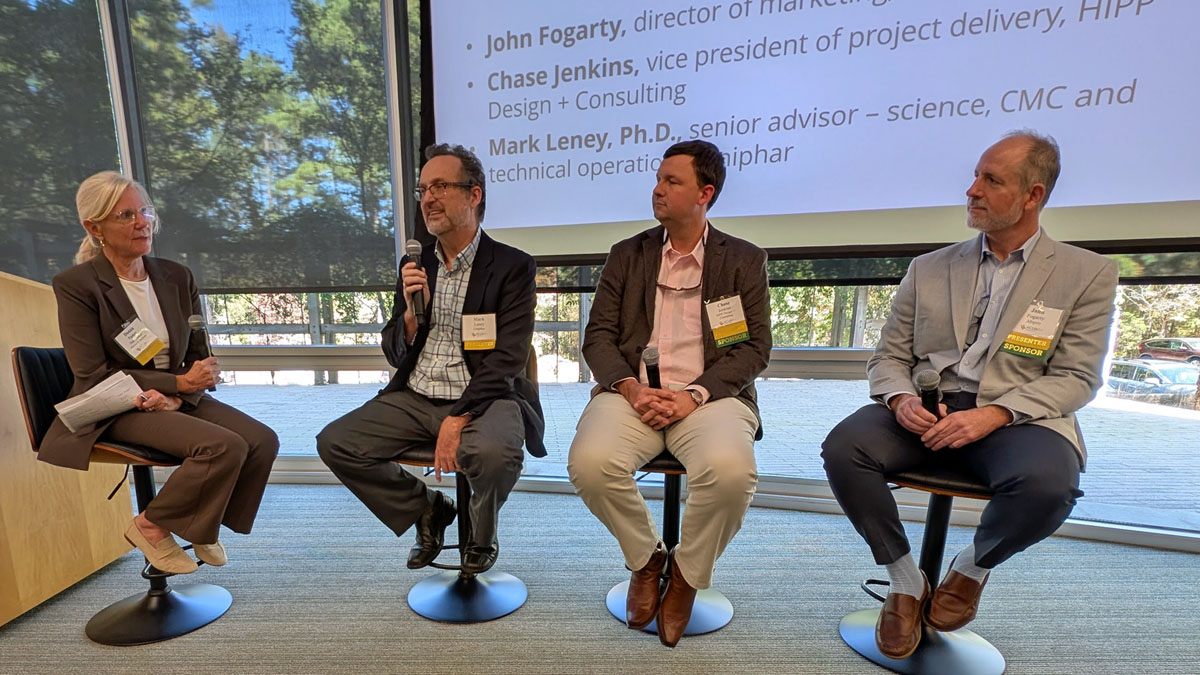
Capital efficiency, outsourcing decisions and early planning for clinical trials framed the discussion at the NCLifeSci Life Sciences Luncheon and Forum "The Path to Success: Concept to Commercialization" on Oct. 29 at the NC Biotechnology Center.
Donna Parker, operations director at i-Cubed, the Center for Clinical Research Innovation at the Duke Clinical Research Institute, moderated a panel of service providers who support companies from early research through manufacturing.
Panelists were
- John Fogarty, director of marketing at Mispro;
- Chase Jenkins, vice president of project delivery at HIPP Design + Consulting; and
- Mark Leney, Ph.D., senior adviser for science, CMC and technical operations at Uniphar.
Clean Harbors, HIPP Design + Consulting, Mispro, NewLife Medicals and VWR, part of Avantor, sponsored the event.
Spend early capital on data, not buildings
Fogarty said tighter funding has made capital allocation the first decision for early-stage companies. He estimated the build-out of a 5,000-square-foot vivarium in Research Triangle Park costs $4 million to $5 million. Staffing, animal care, regulatory oversight and a lease term often longer than a startup's life cycle add to the total, he said.
"I think the most important thing for a company to consider is where their capital is going to have the greatest impact to advancing their science," Fogarty said.
He said companies running several programs might justify a facility of their own. Others should rent space in a contract vivarium or outsource studies to a contract research organization.
Fogarty said investors now expect validated, defensible proof-of-concept data before they commit beyond a seed round. They also look for teams with downstream manufacturing and commercialization experience, he said.
"We're seeing the need, the requirement, for not only validated, defensible proof of concept data, but readiness for downstream growth," he said.
Leney agreed startups should not build manufacturing or animal facilities. "Other people know how to do that better," he said.
Ankit Shah, founder and medical director of NewLife Medicals, said from the audience many companies now form strategic collaborations across discovery, formulation and manufacturing to stretch limited budgets in the race to bring molecules to market.
Focus on what the FDA needs for Phase 1
Leney said an early-stage company must choose a target patient population and indication from the start, even if the company later changes course.
"What you can't end up doing is drifting and not being clear," he said.
He said founders from academia often run long series of mechanistic studies better suited to publication than to raising investment or filing an investigational new drug application. Investors want enough work to reach the next milestone without excess, he said, and FDA requirements for Phase 1 differ from commercial standards. According to Leney, the FDA has pushed back on industry complaints about Phase 1 delays and pointed instead to companies conducting more studies than required.
"You only need one killer study to demonstrate the mechanism," Leney said. "There has to be a pathway, but it's got to be lean."
Build flexibility into facility plans
Jenkins said companies planning for growth two to three years out should avoid locking themselves in. In smaller leased spaces, he said, companies gain flexibility by leasing extra space, negotiating first right of refusal on future space and designing layouts for expansion.
"As soon as you figure something out in your commercialization process, it changes immediately," he said.
He recommended adding validation, manufacturing operations and regulatory staff to project teams early. "They're invested in the success of that company," he said.
Jenkins said short-term leases and lease-to-own arrangements with developers help companies move into space quickly while keeping options open. Discussions about shared, leasable cGMP space continue, he said, though FDA requirements present challenges. Leney said he has not seen shared GMP space succeed but pointed to professional GMP operations at academic medical centers and universities, including Harvard, Baylor and the University of Iowa, as workable partners.
Asked how often an early feasibility study leads a client away from a project, Jenkins estimated two-thirds to three-quarters of the time.
"I actually feel a lot of joy with my clients when I can say this doesn't make sense," he said. "I feel like you're putting someone on the right path to be successful."
AI speeds discovery and documentation
Leney said he reviewed about 130 submissions this summer for a government project to design a new class of molecule. Of roughly 100 with scientific merit, about 80 involved machine learning in early discovery, he said, and he recalled all nine funded projects used some form of machine-enhanced technology.
He said AI has also cut the time he spends preparing regulatory documents and reports. He has not yet seen AI affect clinical work, he said.
Fogarty said AI use in preclinical animal research centers on software and study processes. Much early preclinical data stays unpublished, he said, which limits the information AI tools draw on. He also noted growth in companies describing themselves as AI biotechs, which use proprietary AI engines to move faster but still need animal data.
Jenkins said AI helps his firm deliver scenario analyses to clients sooner. "And kind of get them to where they can use data to make decisions faster," he said.
Avoidable mistakes in CMC, endpoints and assays
Leney identified three gaps. The first involves chemistry, manufacturing and controls, or CMC. He urged companies to have experienced quality professionals review a lean CMC package before submission. A real CMC problem raised by the FDA late in the 30-day IND review window leads to a clinical hold, he said.
"Investors hate that," he said. "It's really hard to get off clinical hold."
The second involves endpoints. He urged companies to consult clinicians and payers early to define an endpoint both measurable within budget and meaningful to patients, families, doctors and payers.
"The endpoint has to be doable, achievable, but it also has to be meaningful," he said.
The third involves bioassays. Companies do not need a validated pharmacokinetic or pharmacodynamic assay to file an IND, Leney said, but they need one ready, with analyte stability data, when the first clinical samples arrive. He said he has seen one company fail after discovering its analyte was unstable in plasma.
Jenkins said sponsors of advanced therapy trials should weigh the burden on patients. Many such trials take place at a single site and require critically ill patients to travel and stay for days, he said. He suggested mobile care and in-home nursing to reduce dropout, along with dry runs of cold chain shipments to trial sites.
"We're delivering to the patients in the end, and I think that can get lost through the clinical process sometimes," Jenkins said.
Fogarty said reproducible preclinical data reduce risk at later stages. "Some of the best feedback we get from clients is thank you for letting me realize this didn't work," he said.
Telling the industry's story
Asked who should take part in policy discussions about new approach methodologies, or NAMs, such as organoids and organ-on-a-chip systems, Fogarty said experienced scientists need a seat at the table. He said the industry supports reducing animal use in research, but no validated replacement for data from living systems exists yet.
Fogarty said the industry needs to communicate the stories of patients and the personal motivations of the researchers who serve them.
"There's a lot of founders who have personal stories for the disease area that they're in," he said. "Those stories need to be told."
Leney said small companies stand to gain the most from NAMs but lack the time and stability to engage in policy debates. That work falls to industry groups, including state and regional biotechnology organizations and BIO, he said.
Capital waits on policy clarity
Jenkins said tighter capital and political uncertainty, including the upcoming midterm elections, have led many clients to commission early designs and cost estimates, then pause before committing.
"There's very much like a wave that it feels like is about to break loose," he said.
Fogarty described similar hesitancy across research, real estate and construction. He said a pause in National Institutes of Health funding affected Mispro's business more than any other factor. Other nations, including China, are investing in science, he said, and the United States should do the same.
"The United States needs to be pro science," Fogarty said. "We're on the edge of some major breakthroughs in some of the key disease areas."
Parker closed the panel by urging attendees to prepare.
"We are holding back a wave, and this wave is going to hit at some point," she said. "That means that everybody in this room needs to get their businesses ready for the wave to hit."