
Forum panel: AI value in medical devices depends on solving real problems, not chasing trends
Artificial intelligence holds significant promise for medical devices and clinical care, but its impact depends on applying the right tool to a well-defined problem, and navigating a regulatory environment that is struggling to keep pace with the technology. Those were among the central conclusions of a panel discussion held June 4 at the NC Biotechnology Center during an NCLifeSci Life Sciences Luncheon and Forum focused on machine learning and AI.
The panel, titled "Machine Learning and AI," drew on perspectives spanning medical device engineering, clinical medicine, industry standards development and cloud computing. Moderated by Zack Hornberger, senior director, digital health and imaging technology, AdvaMed, the discussion featured:
-
Patrick Downie, senior director, digital engineering, BD;
-
Tom Kaiser, M.D., Ph.D., chief scientific officer, Avicenna Biosciences; and
-
Todd Sharp, field CTO and principal technical executive adviser, global healthcare and life sciences team, Amazon Web Services.
The event was sponsored by Egnyte, K&L Gates, PCI, PSC Biotech and VWR, part of Avantor.
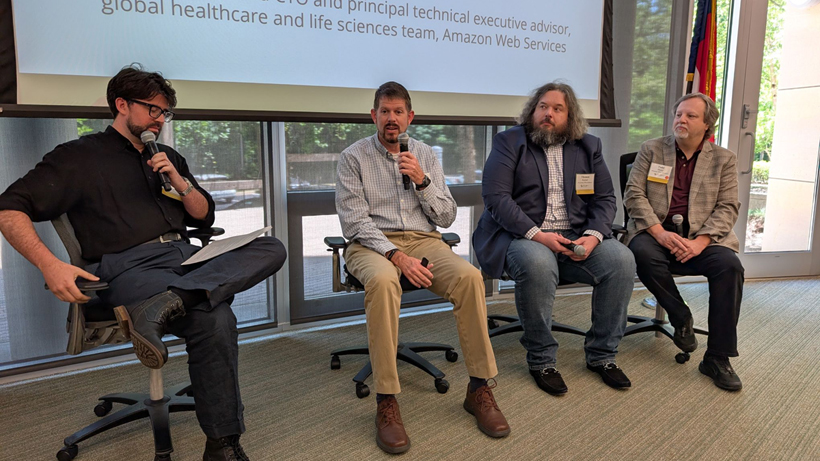
Advamed's Zack Hornberger, BD's Patrick Downie, Tom Kaiser, M.D., Ph.D., of Avicenna Biosciences; and Todd Sharp of Amazon Web Services
Where AI is adding value today
Hornberger opened the discussion by asking panelists where they see AI creating real value in healthcare and medical devices. Kaiser, a physician and mathematician who uses machine learning to design neuromodulation therapies at Avicenna Biosciences, said the clearest gains come from automating tasks that consume significant clinician time but do not require complex judgment.
He pointed to diagnostic specialties such as pathology and radiology, where AI tools help practitioners triage their caseloads more effectively. A radiologist reviewing 80 to 140 images in a single day faces the real risk of missing something, Kaiser said. AI front-loads that challenge.
"One thing that can really make a pathologist's workflow much more straightforward is the machine saying, 'You need to focus on these because I'm really unsure about what this is,' and then that expert can come in and spend a lot of time getting the diagnosis right," Kaiser said.
Downie, whose team at BD focuses on virtual design and simulation work conducted before devices reach regulatory review, described a different but complementary application. His engineers use AI-enabled tools to run optimization studies and explore design spaces, testing whether devices will remain robust across the full range of manufacturing variation they will experience over decades of production.
He pointed to a concrete example: BD's development of the Vacutainer Barricor, a blood collection tube with a mechanical separator that eliminates the gel component traditionally used to separate plasma from red blood cells during centrifugation. After 131 unsuccessful optimization runs, AI helped identify a design that worked.
"I remember very fondly when we finally hit the one that worked — holy cow, it works," Downie said. "Optimization run number 132 is the origin story of that product today. A lot of work went on after that."
Sharp, drawing on his work with healthcare and life sciences customers at Amazon Web Services, described the broader pattern he sees across the industry. Of roughly 1,400 to 1,500 FDA-approved AI algorithms, Sharp said fewer than 100 are operating at scale, and only about 2% have randomized trial data supporting their long-term efficacy.
He described one area where AI is demonstrating clear returns: radiology triage in hospital settings. When AI helps a radiologist work through a larger imaging queue, it not only improves patient care but also helps hospitals generate more revenue from expensive diagnostic equipment by reducing missed and vacant slots. Sharp said U.S. hospitals are operating on average margins of about 3%, with 796 hospitals at risk of going out of business or being absorbed through merger and acquisition.
"It was about a 54% increased revenue cycle for an asset in a hospital based upon AI at the front end helping with triage," Sharp said.
Kaiser added that the emergency medicine setting is another area of urgent need. As emergency departments increasingly serve as primary care for many patients, AI imaging tools that triage cases by confidence of diagnosis allow physicians to move patients more quickly to the appropriate level of care, a benefit that matters particularly for remote hospitals without full-time radiology staff.
The gap between approval and adoption
Sharp's observation about the small fraction of approved AI tools that actually reach scale prompted a closer look at what separates the tools that succeed from those that do not. Sharp said the tools seeing meaningful adoption have solved more than just the clinical or technical problem. They have also figured out reimbursement, workflow integration and the human factors that determine whether clinicians actually use them.
"The last thing you want to do is go into a facility today and put a new workflow in front of them," Sharp said. "We are not a mission-critical industry, we are a life-critical industry."
He emphasized that AI tools succeeding at scale fit into existing workflows without forcing clinicians to adapt to new systems. The cognitive load on healthcare workers is already high, he said, and adding friction to a workflow undermines even a technically sound product.
Kaiser addressed the same issue from a clinical perspective. The regulatory bar for devices entering the clinic in the United States is lower than in Europe, where he trained as a physician, he said. He suggested the U.S. could benefit from taking a closer look at how other countries evaluate devices for both safety and efficacy, not just safety.
"It's not enough to just not hurt people, that's easy to do," Kaiser said. "Safety plus efficacy is what drives value in the clinic."
He referenced a concept used in the United Kingdom called the quality-adjusted life year, which measures the value of a medical intervention in terms of its effect on a patient's length and quality of life. While that specific framework is rarely applied to devices in the U.S., Kaiser said medical devices are well suited to that kind of evaluation because they tend to involve shorter-term interventions that are more measurable than drug therapies.
Navigating the regulatory environment
The regulatory conversation touched on both the domestic and international environment for AI in medical devices. Sharp described a compounding pressure facing companies of all sizes: in Europe alone, six major regulatory acts affecting medical devices, including the EU AI Act, the In Vitro Diagnostic Regulation and the Medical Device Regulation, are all coming due within approximately two years, he said.
Sharp said the regulatory burden falls disproportionately on smaller, innovative companies that lack the compliance infrastructure of large multinationals. He argued that AI is one of the few tools that helps level that playing field, automating document management, workflow compliance and security controls so that smaller companies manage the administrative load more efficiently.
"The promise AI has in bringing innovation to market is that it levels the playing field with respect to the administrative burden, so those innovative ideas aren't being lost to the economics being out of whack," Sharp said.
Downie described how his team at BD interfaces directly with the FDA through physics-based simulation work. A cross-industry standard called ASME V&V 40, developed over approximately five years with input from BD team members, provides a framework for simulation-based regulatory submissions that the FDA recognizes. His team recently answered a series of FDA questions about a product submission entirely through simulation results.
"There's a lot of work that went into getting to that point in the agency and in the medical device community, but it is today how my team interfaces directly with regulatory agencies," Downie said.
Kaiser raised a broader gap in the oversight of AI tools used in clinical settings that do not fall under FDA device regulation. He pointed to clinical calculators used by physicians, some generated by analyzing large sets of clinical records, that operate without any formal oversight of their accuracy or reproducibility. He called for the development of a "good AI practice" standard, analogous to good manufacturing practice, that would establish clear expectations for AI tools used in clinical decision-making.
"Can the FDA issue guidance for what ought to be done before you enter into the clinical setting, so that it's controllable, it's reproducible, and we make sure that we're actually having a positive impact in patient outcomes?" Kaiser said. "That is missing right now."
Hornberger, who is involved in international standards development at AdvaMed, said standards bodies such as the International Electrotechnical Commission are working on AI safety and performance standards for medical devices, but the process of developing those standards takes six to 10 years. By the time a standard developed today comes to fruition, the technology it addresses will look entirely different.
AI in the Triangle
Hornberger asked the panelists to reflect on AI and machine learning work happening in the Research Triangle area. Kaiser pointed to Duke University and the University of North Carolina at Chapel Hill for their work in medical informatics and point-of-care diagnosis. He also described the work at Avicenna Biosciences, where machine learning has dramatically compressed the early stages of drug design.
"It used to be the case that you needed 1,000 compounds to make it through a design cycle," Kaiser said. "We found two clinical candidates in 11 compounds."
Sharp described the Triangle as a rare ecosystem, one that combines academic research, commercial manufacturing, clinical infrastructure and regulatory expertise in a way that is difficult to replicate elsewhere.
"You come here to the Triangle and it is a unique ecosystem," Sharp said. "There's nowhere else in the world that I've been that has so many success stories with AI, with surmounting regulatory challenges, with taking ideas from academia and seeding it into commercialization."
He cited Triangle-area companies working on AI applications in prostate cancer diagnosis, reducing false positive rates by approximately 70% and accelerating results by 44%.
Keeping humans in the loop
An audience member raised a question about whether widespread AI adoption risks eroding the critical thinking skills of the clinicians and engineers who use it. The panelists were clear: expertise matters more now, not less.
Kaiser said that as AI becomes more specialized, the practitioners working with it will need deeper discipline-specific knowledge to interpret and apply it correctly. Machine learning for pathology and machine learning for radiology are not the same, and only a trained practitioner understands the difference, he said.
Downie said his team's approach to AI-generated results is to verify outputs repeatedly rather than simply trust them.
"We don't trust, but we verify 10 times over, because there are a multitude of places where information can get lost," Downie said. "You still have to have people that are in the loop. This is going to require more deep thought, not less."
Sharp said early research indicates AI consumption is already associated with some cognitive decline in certain areas. His response was to focus on developing creators rather than consumers, people who understand and shape the AI tools they use rather than simply accepting their outputs.
Advice for founders
The panel closed with advice for companies looking to build AI into new medical devices. Sharp's guidance was direct: start with the customer and their problem, then work backward.
"You're not going to put AI in something just because you want AI, or your board wants AI," Sharp said. "There needs to be something you're solving for. AI is not always the solution. AI without ROI is an academic trial."
Kaiser emphasized the importance of a clear target product profile, a precise articulation of the problem to be solved and the needs of the intended market. He also raised the challenge of bridging the communication gap between technologists, scientists and clinicians who may use the same terminology to mean different things.
Downie described the discipline his team applies to device validation: repeated cycles of virtual and physical prototyping, followed by close examination of failure modes when products return from the field.
"You need to make sure that you are understanding the exact application that you're designing towards, and that the space that you're moving into, when you get it out into the real world, is nearly equivalent," Downie said. "If you're extrapolating well beyond your known data set, well, anything can happen."