
AI in biomanufacturing takes center stage at Q2 Biotechnology Manufacturers Forum
Representatives from Eli Lilly & Company and Merck shared how their North Carolina manufacturing sites are putting artificial intelligence to work on the shop floor at the June 17 meeting of the NCLifeSci Biotechnology Manufacturers Forum at the NC Biotechnology Center.
Kathleen Kelsey, senior director of RTP Manufacturing IT at Eli Lilly, and Michael Fields, senior director of RTP Device Assembly Operations at Eli Lilly, described the company's digital plant strategy and two AI applications already running at the Research Triangle Park site. Amanda Taylor, Durham plant manager for Merck, Joe Ganshaw, digital manufacturing operations lead for Merck Vaccines, and Jessica Dulkis, technical operations and digital lead at Merck, outlined the company's framework for driving AI adoption and walked through two use cases from the Durham vaccine manufacturing site. Morgan Daniels, CEO of Continuum Consulting, moderated the presentations and facilitated the discussion that followed.
Eli Lilly: building a digital plant from the ground up
Kelsey opened by describing the broader context for Lilly's AI work. The company is in the midst of a rapid growth phase, and leadership determined early on that the old ways of operating would not support that ambition.
"We can't be successful with all of this ambitious agenda by continuing to do things the way we did them before," Kelsey said.
The RTP facility, which began a major expansion in 2020 and is nearing full buildout, was designed from the start as a digital plant. Lilly describes the facility as a plant of the future, and what the company learned building it has become the standard for new manufacturing sites across the company. A cross-functional digital transformation strategy built around four pillars — all of which lean heavily on data and analytics — guides the work.
Kelsey said Lilly has developed a culture of iterating quickly, learning from what doesn't work and applying those lessons to the next use case.
"Maybe the use case itself doesn't work, but what can you learn from it, and what can you apply to another use case that maybe does provide more value," she said.
Fields took the forum through two specific tools the RTP site has deployed.
The first, called Amigo, addresses the challenge operators face managing highly complex, high-speed assembly lines. The lines run at 350 parts per minute, generate more than 10,000 unique alarms per line and span two stories, meaning no operator has a full line of sight from any single position. Operators deal with hundreds of data points per shift and can quickly shift into reactive mode.
Amigo uses generative AI to give operators a simple question-and-answer interface. An operator can ask whether intervention is required for the current batch, and the tool draws on real-time line performance data and historical information to return a prioritized list of the most impactful issues along with an objective estimate — in hours or minutes — of how much each issue will affect the rest of the batch.
"What that does is it allows the operators to really make that game-time decision of should I actually stop the line and fix the problem, should I get engineering or maintenance proactively over here," Fields said.
The second tool uses machine learning to help engineers understand what is driving downtime at bottleneck stations on lines that operate asynchronously — meaning individual modules can go up and down independently. The algorithm, developed in partnership with Lilly data scientists, gives engineering and support staff a three-month, six-month and one-year view of the most impactful issues on each line so they focus continuous improvement efforts where they matter most.
Looking ahead, Fields said Lilly's target is agentic AI — networks of AI agents that automate and optimize recurring tasks currently handled by people. The company is working toward deploying 20,000 to 30,000 agents across the workforce, with one early example being a process team agent that automates data collection and reporting for tier reviews.
"We are ensuring that as we are enabling and turning on this technology, we're always keeping human in the loop and explainability to ensure that in this heavily regulated environment, we are very careful about how we scale this," Fields said.
Merck Durham: A framework for adoption in a commercial environment
Ganshaw opened the Merck presentation by describing the challenge of moving AI into a live commercial manufacturing environment — where the stakes around compliance and product quality are high and where employees are watching how leadership responds to a technology many find unsettling.
"There is a lot of fear out there," he said. "Is this going to take my job?"
To address that, Merck Durham built its AI adoption approach around three elements on the "what" side — setting expectations, establishing guardrails and defining outcomes — and three on the "how" side — organizational structure and governance, AI type and initiative levels, and upskilling by persona.
Guardrails cover privacy, proprietary data and the principle of keeping humans in the loop. Merck is not using AI to make batch release decisions. On governance, the company uses a top-down, bottom-up pyramid structure: a center of excellence at the enterprise level works on solutions that span the network, while sites drive grassroots innovation at the base.
To prevent duplicate work as AI tools multiply across the network, Ganshaw said the company is developing a guided playbook that walks teams through a standard set of questions before they build anything — whether it is in GMP space, how broadly it will be deployed and whether a tool already exists.
Upskilling is organized around three personas. Operators and technicians need to know how to write an effective prompt. Technical staff in maintenance and operations need the skills to build and use tools on the company's data platform. A smaller group of advanced users focuses on enterprise-level solutions.
Dulkis, who serves as the Durham site's AI champion, presented two use cases her team has deployed. She opened by naming the context directly.
"Driving AI adoption in a commercial environment is very difficult," she said. "What we're trying to do is difficult, and I want to acknowledge that for everybody in the room."
She said the site has deliberately focused its GMP AI work on knowledge management, where regulatory expectations are clearer and business value is easier to demonstrate.
The first use case addresses discard analysis. When Merck discards a batch, a manufacturing deviation and corrective action plan are generated at the site level. Across a global network, hundreds of batches and deviations accumulate each year, making it difficult for enterprise leadership to identify patterns and make informed decisions about where to invest resources.
The team built an AI-enabled web application that uses a pipeline of tools to process deviation records, identify which deviation caused each discard, generate a 100-word AI summary and make the data navigable through a chat interface. A plant manager can ask, for example, which standard operating procedure is most responsible for human-related deviations, and the tool will answer with a reference to the underlying data. An AI-enabled chart creation feature lets users build visualizations on demand.
The Durham team used the tool to identify their lyophilizers — eight units across two buildings, each 10 years old and holding 18 shelves of 6,000 vials — as the equipment most in need of attention.
That finding led to the second use case: real-time equipment monitoring and response. The team used the data they had mined to train 50 anomaly detection conditions on the lyophilizers using a self-service analytics tool. But anomaly detection is only useful if staff can respond quickly, and Dulkis said the initial rollout ran into a predictable objection from the maintenance team.
"I have 50 more things to respond to," she said. "I can't respond to that, particularly if you are the brand-new tech on night shift and you've never worked on this equipment before."
To close the gap between detection and action, the team built a retrieval-augmented generation chat interface — using Dataiku and Python Dash — that gives maintenance technicians access to more than 10 years of historical problem-solving knowledge. A technician encountering an unstable shelf temperature during primary drying can ask the tool what to do, and it will return the most relevant GMP source documents with specific page and work order references, a five-to-10-step troubleshooting guide and compliance recommendations for how to document the work in the manufacturing execution system.
"We still have that human in the loop," Dulkis said.
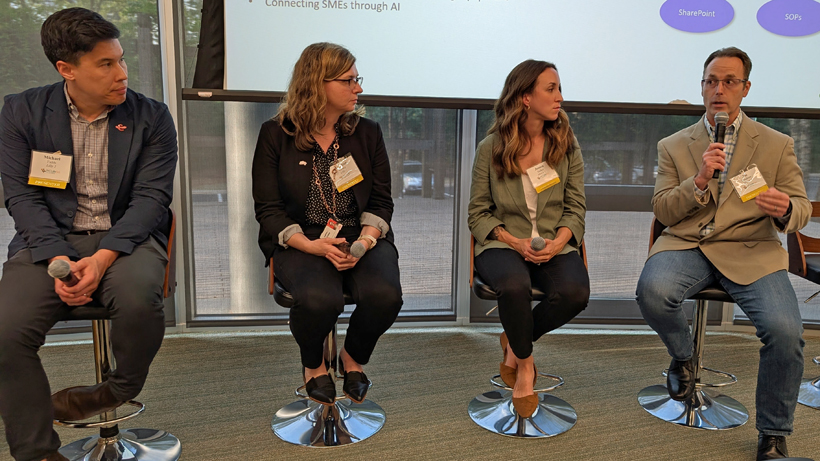
Discussion: skills, guardrails and what the industry needs
Following the presentations, Daniels invited the presenters to take audience questions. Two topics drew extended responses.
The first was workforce skills. Fields said openness to change is the most critical quality for operators entering an increasingly automated environment. He described how Lilly's operations teams are building new expectations into standard roles that reward employees who embrace the technology and serve as models for colleagues. Fields also noted that the company works closely with BioNetwork, Wake Technical Community College and Durham Tech through apprenticeship programs — including a mechatronics maintenance program — to define what foundational skills look like for the next generation of manufacturing workers.
Ganshaw said the more durable skill is critical thinking — the ability to question what an AI output is not telling you.
"There are very convincing results that come out when you prompt AI," he said. "So I think we also need to be focused heavily on that critical thinking."
Dulkis added that a fundamental understanding of what AI actually is — at the level of basic math and probability — would go a long way toward building trust among operators who do not yet know when to rely on the technology and when to push back.
"When you boil AI down to the core fundamental understanding of what is it, math, then it becomes much more palatable to people, and the trust is better there," she said.
The second question addressed how organizations ensure guardrails are universally accepted as AI tools scale across sites. Ganshaw acknowledged the work is still in progress. Merck is building compliance checks into the playbook rollout and plans to use automated agents to audit other agents for adherence to guardrails.
"I don't know yet — that's the truth," he said. "But as we're rolling out this playbook, we're going to go start collecting some data."
Forum business
Before the presentations, NCLifeSci President Laura Gunter delivered legislative updates on state and federal policy.
At the state level, the Life Sciences Caucus co-chairs introduced an omnibus life sciences appropriations bill covering early-stage innovation, NC Biotechnology Center funding, the Rare Disease Advisory Council, water and wastewater infrastructure and a reserve fund for federal matching grant opportunities. Gunter said the bill is unlikely to move in the current short session but serves as a framework for future legislative cycles. She noted that a water and wastewater recoupment provision — which would allow the Department of Commerce to commit to covering up to 50% of wastewater infrastructure project costs, capped at $50 million, over 10 years — is particularly relevant to manufacturers considering expansion. Some concerns remain about how the provision interacts with the Job Development Investment Grant program.
At the federal level, Gunter reported that SBIR and STTR reauthorization was finally approved this spring. She flagged the administration's continued announcements of most-favored-nation-type pricing settlements with pharmaceutical companies and the proposed GUARD and GLOBE models, which would extend international reference pricing to Medicare Parts B and D. She also urged members to engage with proposed rule changes to the Regulation for Federal Financial Assistance — which would subject federal research funding decisions to political review — before the comment period closes July 13.
BMF Chair Bill Monteith outlined the remaining 2026 forum schedule: Q3 will focus on non-traditional skills-based development on Sept. 23, and Q4 will cover regulatory benchmarking on Nov. 3. The Annual Site Leadership Dinner is set for Aug. 19. Monteith said the BMF plans to restart its digital manufacturing discussion group following the AI session and that a sustainability discussion group is exploring work with the BSR Waste Management Team. He noted that drought monitoring continues on a weekly basis following a May 7 special meeting with the N.C. Department of Environmental Quality on contingency plans.
NCLifeSci Workforce Director Jenae Williams updated members on the NCBioImpact Network's road to 25 years. The network's first industry-academia exchange fair, held April 8, drew 171 attendees representing more than 40 companies and received a 100% satisfaction rating from survey respondents. Williams said planning is underway for a second fair. Two upcoming events from the NCLifeSci Diversity, Equity and Inclusion Committee were also announced: a virtual mental health lunch-and-learn planned for Aug. 18 or 20 and a face-to-face event on coping with attacks on DEI planned for Nov. 13, sponsored by Merck.