
NC life sciences community gathers for first NCBioImpact industry-academia exchange
More than two decades of workforce collaboration came into sharp focus on April 8 when NCBioImpact hosted its first Industry Resource Exchange Fair at the NC Biotechnology Center in Research Triangle Park.
The event drew more than 170 attendees from partner organizations across education, workforce and industry, all gathered to share resources, build new partnerships and take stock of one of the strongest life sciences manufacturing ecosystems in the world.
The event featured collaboration zones spread across two floors — STEM Outreach, Degreed, BioWork, Short Course and Certification, Hiring — three auditorium presentations and a ceremony and reception honoring NCBioImpact's founding institutions. Attendance drew hiring managers, HR leaders, site heads and training professionals and employees seeking development from across the state, reflecting the urgency behind a workforce challenge that shows no sign of slowing.
Laura Gunter, president of the NC Life Sciences Organization, opened the event with a brief history of the coalition's origins and a direct call for continued collaboration.
"Almost a quarter century later, NCBioImpact continues to make a true impact on the life sciences talent ecosystem," Gunter said. "It is a model for specialized workforce development across the country and the world."
Bill Bullock, senior vice president of economic and statewide development at the NC Biotechnology Center, offered context for just how much ground the state has covered. When NCBiotech first measured the total economic impact of life sciences in North Carolina in 2008, the number came in at just over $45 billion. Two years ago, it reached $82 billion.
"I think we feel pretty good that that could be a $100 billion number by 2030," Bullock said.
NCBioImpact: What it is and why it matters
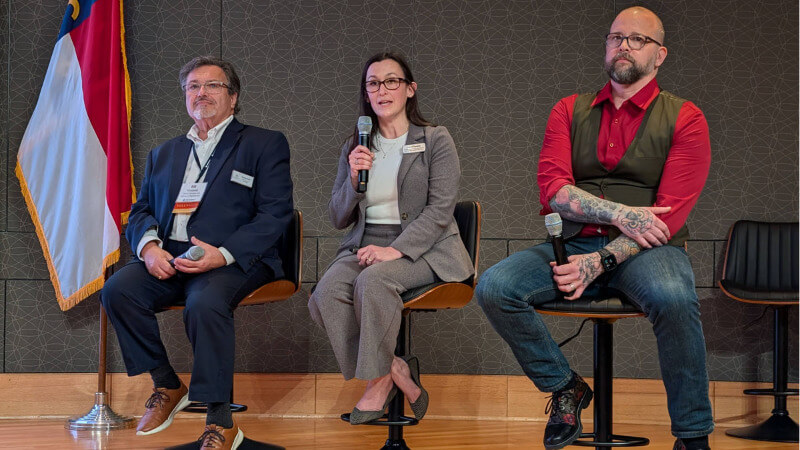
NCBioImpact is a public-private workforce development coalition that connects universities, community colleges, government agencies and nonprofit organizations with life sciences manufacturers across North Carolina. Its mission is to increase the availability of trained life sciences manufacturing workers by linking educational resources to industry needs. The coalition has operated for more than 23 years and counts a workforce of 36,000 — and growing — as one of its core achievements.
Bill Montieth, program manager of the NCLifeSci Biotech Manufacturers Forum and the event's emcee, noted that industry awareness of NCBioImpact as a unified entity remains a work in progress.
"About three years ago, I started in this role and asked a room of site heads, 'Who knows what NCBioImpact is?' There were 40, and one person raised their hand," Montieth said. "A lot of people know a lot of the institutions that make up NCBioImpact but didn't realize what NCBioImpact was itself."
John Balchunas, workforce director for NIIMBL, traced the coalition's origins to the late 1990s when biomanufacturing companies began recognizing they needed a shared talent pipeline. He noted that the region's reputation for workforce development now extends well beyond North Carolina's borders. During a recent trip to South Carolina, Balchunas heard site-selection professionals tell a room of economic developers that North Carolina had a 40-year head start in life sciences manufacturing.
"Their answer was blunt, and they were almost unanimous: 'You're not going to catch them. You might as well pivot to another industry,'" Balchunas said.
Laura Rowley, Ph.D., vice president of life sciences economic development at NCBiotech, highlighted the role NCBioImpact's established relationships played in securing a $25 million federal Economic Development Administration Build Back Better grant.
"But for those established relationships, I don't know that we would be where we are today," Rowley said.
The grant supported the BioBetter Consortium through the NC Community College System, expanded programming for HBCUs and HAIUs through the HBCU/HAIU Coalition led by BRITE at NC Central University and funded community engagement work led by NCBiotech.
Rowley pointed to the statewide growth data as a sign of what the coalition's work has made possible. Companies announced more than 9,200 new life sciences jobs in North Carolina between January 2022 and January 2026, with significant investment coming from Genentech, Johnson & Johnson, Novo Nordisk, Biogen, Amgen and others. Manufacturing now accounts for nearly half of all life sciences employment in the state — roughly 37,000 of 76,000 total workers.
The Q&A session that followed raised several forward-looking concerns. Workforce demand topped the list, with speakers noting that companies are struggling to find skilled trade workers — mechanics in particular — who also understand GMP requirements. Automation and artificial intelligence emerged as a secondary challenge. Balchunas called out the need for data scientists and statisticians with life sciences knowledge.
"The industry is looking for statisticians and data scientists coming from degree programs that don't know the life sciences industry," he said. "That's a whole other challenge that the big 'we' needs to figure out how to solve."
A question from Anil Goyal, founder of Open Doors Group, raised the issue of R&D growth, noting that North Carolina has long been celebrated for manufacturing but has lost ground in research and development relative to clusters in Boston and San Francisco. Montieth acknowledged the point directly.
"Maybe we need to be thinking about how we start a similar type of research-focused side that includes NCBioImpact and the NC Biotechnology Center, as well as the NC Life Sciences Organization," Montieth said.
University collaboration for GMP biomanufacturing
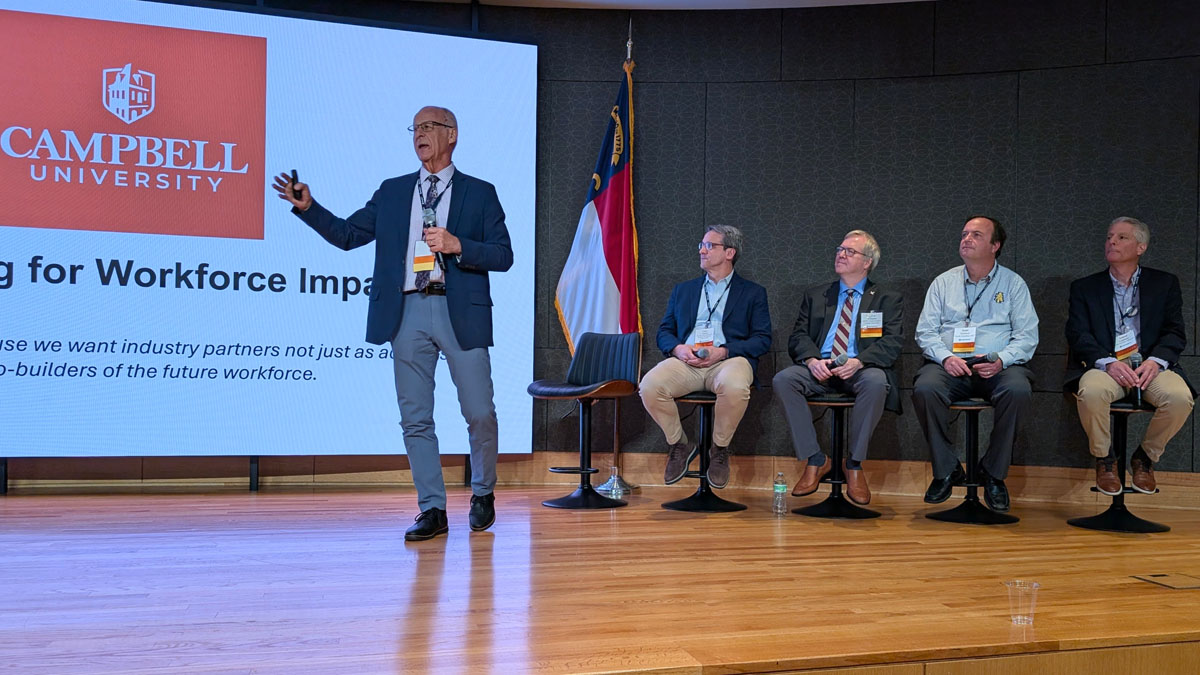
The second auditorium session addressed the quarterly topic that site leaders selected at last summer's Biotech Manufacturers Forum annual meeting: How university systems and the life sciences industry can collaborate to build a reliable workforce, including professional development pathways.
Representatives from five institutions — Campbell University, East Carolina University, North Carolina Agricultural and Technical State University, North Carolina Central University and North Carolina State University — each presented their programs, facilities and partnership models.
Charles Carter, Pharm.D., chairman of the Department of Pharmaceutical and Clinical Sciences at Campbell, described a new strategic plan that places workforce alignment at the center of the university's direction. Campbell is developing a fully online master's program in CMC administration and AI-driven quality leadership, built around what Carter called "Pharma 4.0" principles, with stackable credentials shaped directly by industry input.
"We can't do this without the industry," Carter said. "We need advisers to help shape the curriculum and competencies. We need industry co-builders to teach as adjunct scholars, and we need real-world engagement to provide capstone challenges and sponsor employees."
Loren Limberis, Ph.D., representing ECU's Eastern Region Pharma Center, described a center that serves as a workforce development facilitator for the biopharma sector in eastern North Carolina, covering degree programs, a nondegree pharma sciences and technology certificate, GMP labs and remote access to analytical equipment. He pointed to PharmaFest — an annual on-campus event open to all ECU students regardless of major — as a concrete way for industry to connect with students.
"Everyone's invited, not just the typical students from engineering, biology and so on, and chemistry, it is finance majors, Logistics and Distribution, computer science, everything," Limberis said.
Scott Harrison, Ph.D., associate chair of the Department of Biology at NC A&T, introduced the university's new postbaccalaureate certificate in biopharmaceutical operations, launching in fall 2026. The program covers aseptic processing, operations management, biopharmaceutical compliance and experiential training, and is designed to be stackable into a full interdisciplinary master's degree. Harrison also pointed to NC A&T's 4,000-square-foot Merck Biotechnology Learning Center and a recent $4.5 million Department of Education grant supporting an interdisciplinary biomedical engineering facility.
"AI is a thing," Harrison said. "We're building that into all that we're doing in our curriculum as well."
Kevin Williams, Ph.D., a professor at BRITE at Central, highlighted the center's track record: more than 450 degree graduates, a 100% placement rate within six months for both undergraduate and graduate students and an 85% retention rate in North Carolina. BRITE's articulation agreements with Durham Tech and Vance-Granville Community College, along with lab-based externships for community college students, extend the center's reach well beyond the NCCU campus.
"Our students are ready to work, day one," Williams said.
Gary Gilleskie, Ph.D., executive director of BTEC at NCSU, described a facility with more than 43,000 square feet of instructional lab space, $20 million in equipment and a simulated GMP pilot plant. NC State's BTEC graduates about 90 to 100 students annually, with approximately 95% placed in biomanufacturing jobs within six months and 85% staying in North Carolina.
"Many of your companies have hired the students that we are putting into the industry," Gilleskie said.
He invited industry partners to visit the zones during the resource fair to discuss how BTEC should best implement AI instruction and expand into drug product manufacturing, areas Gilleskie identified as priorities for the center's next phase.
Community college programs: how connecting can fuel your pipeline
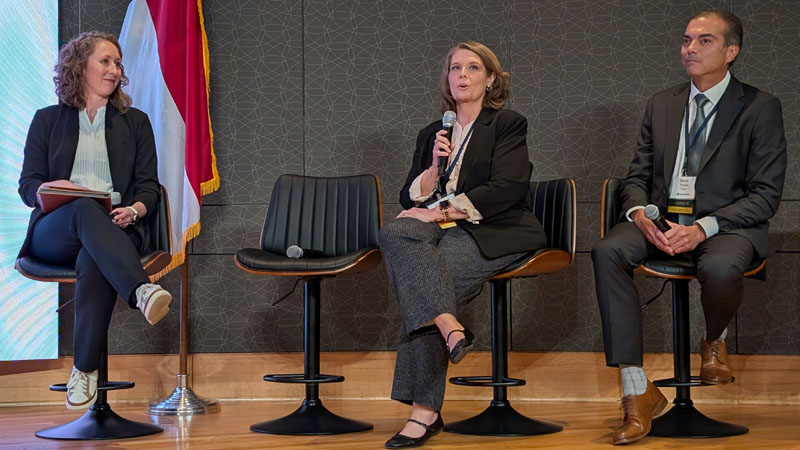
The day's final presentation examined how community colleges fit into the talent pipeline and how structured relationships between colleges and employers translate into tangible workforce outcomes.
Brian Stoker, speaking on behalf of Grifols, opened the session by describing his company's 25-year partnership with Johnston Community College. He highlighted a recent development that allows students to complete the BioWork certificate while still in high school through a combination of on-site workforce training and classroom instruction.
"That means we have students graduating from high school with a BioWork certificate and the ability to enter the workforce immediately," Stoker said.
Lisa Smelser, Ed.D., executive director of workforce strategic initiatives at Central Carolina Community College and the panel's lead presenter, framed the session around scale and structure. She noted that of North Carolina's approximately 38,000 life sciences manufacturing workers, at least 38% do not require a bachelor's degree.
"BioWork has one of the most diverse groups of learners I've ever seen — someone's first college class, a high school student, someone with a PhD," Smelser said. "That course speaks to a lot of people."
Smelser walked attendees through several structural developments in the community college system, including BioNetwork's Capstone Center on NCSU's Centennial Campus operated by Wake Technical Community College. The center trained more than 2,000 learners at 18 companies last year and serves as a resource hub for 14 community colleges. She also previewed an Automation-Ready Technician short course in development, addressing the growing need for technical, digital and mechanical skills in advanced production environments.
On the curriculum side, Smelser described how a 2023 statewide realignment project consolidated five different biotechnology program codes into a single core associate degree, with two pathways — bioanalytical and bioprocess manufacturing.
"We started with the end in mind: what jobs are our students ending up in?" she said.
Stephanie Winstead, biotechnology program coordinator at Wilson Community College, described rapid growth driven by life sciences investment in eastern North Carolina. When she started in 2020, she had two students in her biotechnology program. Today the program has more than 50 students, with nine sections of BioWork running concurrently. The BEST Center — a new $65 million-plus facility funded through the NC General Assembly, Golden LEAF Foundation and other sources — will be ready for course offerings by summer 2027.
"It is going to take all of us — community colleges partnering with our universities, partnering with BTEC and ECU — to meet those workforce demands," Winstead said.
David Posehn, vice president and site lead for Pfizer in Sanford, offered a candid assessment of what has made his site's partnership with Central Carolina Community College effective. He noted that roughly 65% of Pfizer Sanford's workforce currently comes from Wake County and called a 40% local workforce a realistic aspiration — one that depends directly on partnerships with community colleges in the surrounding counties.
"Instead of aggressively competing for the same talent, we have to think more strategically," Posehn said. "We have to partner, understand our shared goals, find the gaps and do things differently so we can create opportunities for others."
On the question of what makes partnerships succeed, Posehn was direct.
"Get the right people involved from the jump. You have to get the right employee, the right colleague — someone who has that energy and passion. Because really, you're making these connections. They have to be able to connect with all of you."
Smelser closed with a note about sustainability that drew from the day's broader themes.
"Small wins over time gets us to where we are. Investment in relationships matters. You spent an entire day committed to building them, and that matters."
Honoring the founders: where it all began
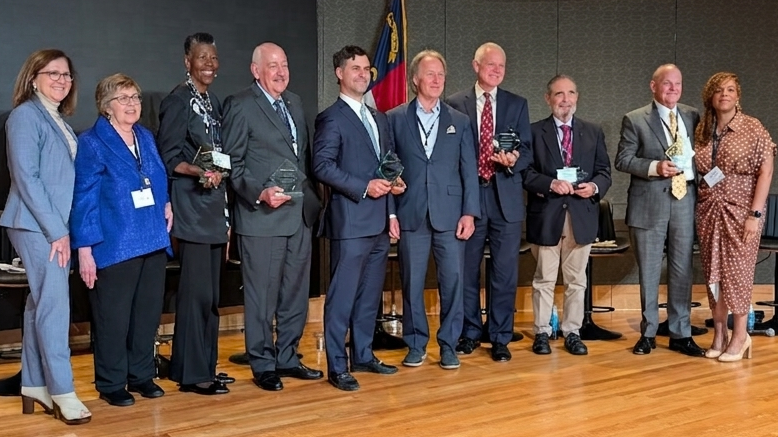
The evening reception brought together several of the men and women who built NCBioImpact from the ground up, and what followed was part history lesson, part reunion. Moderated by Brenda Summers, a former NCLifeSci workforce director who helped organize the NCBioImpact coalition's earliest meetings, the session put faces and stories to an origin that for many in the audience existed only as institutional lore.
The backdrop was North Carolina's early 2000s economic crisis. When the National Association of State Attorneys General reached a $206 billion settlement with major tobacco companies in 1998, North Carolina's three dominant industries — tobacco, textiles and furniture — were already in decline. The human cost was immediate. In 2003, textile manufacturer Pillowtex declared bankruptcy ,and 4,000 workers in Kannapolis and Rowan County lost their jobs in a single day — still the state's largest layoff on record.
Michael Easley Jr., representing his father, former Gov. Mike Easley, described the convergence of crisis and opportunity that shaped the coalition's founding.
"There was opportunity and there was demand and need — two things that can make an industry grow are human capital and financial capital," Easley said. "He saw an opportunity where we could use North Carolina's share of our tobacco settlement money and put it into a foundation known as the Golden LEAF Foundation — Long-Term Economic Advancement — so that money wouldn't be squandered by a legislative body. It would wind up going to help North Carolina's rural economy transition into a new generation economy."
Hal Price, who served as general manager of Biogen's North Carolina facility from 1995 to 2003 and is widely credited as the Biotech Manufacturers Forum's founder, described the staffing problem that first brought industry leaders to the table.
"We were continuously having problems getting trained people," Price said. "The jobs that we had were higher paying and good places to work, but we had to get the word out."
Price credited the late Sam Taylor, then president of NCLifeSci, with recognizing the solution. Taylor proposed bringing government agencies, companies and educational institutions together around a shared curriculum built not around what universities already taught, but around what industry needed.
Summers spoke at length about Taylor's contributions. He wrote the Golden LEAF Foundation grant application, guided the presentations to the foundation's board, organized industry members to lobby the legislature for operating funds, and worked each year to ensure that state budget allocations for BTEC, BioNetwork and BRITE remained intact.
"Sam was passionate about the industry," Summers said, "and he would be amazed at what we are seeing today."
Taylor died of pancreatic cancer in 2021. A scholarship fund established in his memory supports community college students pursuing life sciences careers.
Ken Tindall, Ph.D., retired senior vice president of NCBiotech, described how the late Kathleen Kennedy, Ph.D., the center's director of biotechnology training programs, was instrumental in building the evidentiary case for the initial investment. Kennedy worked with colleagues to develop the first Window on the Workplace report — a survey of biomanufacturers' future staffing needs — that gave the Golden LEAF Foundation the data it needed to justify a major commitment.
"Partnering and collaboration were in her DNA," Tindall said of Kennedy. "There was a need in industry. We listened, and we put together a pretty creative program to make it happen."
Scott Hamilton, president of Golden LEAF, read a letter from Lawrence Davenport, who led Golden LEAF for 25 years and could not attend in person.
"To put more than $67 million in public money in the biotech industry at the time was a very bold move for our board," Davenport wrote. "I sincerely hope that you all believe that together, we set the stage for the tremendous growth that we have seen in the biotech industry."
Mark Sorrells, a senior Golden LEAF staff member at the time of the grant and now president of Fayetteville Technical Community College, recalled that persuading the foundation was not straightforward. Golden LEAF's mandate centered on rural economic development, and an investment concentrated in Research Triangle Park required convincing.
"I literally wore a referee shirt about half the time because it was a competitive landscape," Sorrells said. He argued that the proof of the investment's value came three years later, when a study showed the industry training cycle for new hires — which had run as long as 18 months before graduates could work independently on production batches — had shrunk to six months or less.
"That's return on investment," Sorrells said. "And it's a huge return on investment."
Rosalind "Roz" Fuse-Hall, representing North Carolina Central University, recalled that NCCU arrived at the table with no graduate programs in the life sciences — but with a compelling combination of assets: a biomedical research institute already holding federal grants, Durham County's position as home to the largest concentration of biotech companies in Research Triangle Park, and a track record of graduating diverse students for an industry actively seeking diverse talent.
Ruben Carbonell, Ph.D., a professor of chemical engineering who served as BTEC's director from 2018 to 2022 and later helped establish NIIMBL, described the early NCBioImpact meetings as genuinely uncharted territory.
"We were doing something that had never been done before — at least I had never seen it in my years in academia," Carbonell said. "We were going out of our way, especially in a research university, to create programs on purpose to benefit companies in general. And I have fond memories of all those meetings, because we were discussing something that was kind of cool. We had an open range of things we could try because nobody had done it before."
Carbonell closed with a note of competitive urgency. From his vantage point at NIIMBL, he watches other states studying North Carolina's model and investing to replicate it.
"I'm a very competitive guy," he said, "and I want us to be at first period for years."
Summers, who received a special recognition award from NCLifeSci Workforce and Partnerships Director Jenae Williams, closed the session by drawing a line from the coalition's origins to the room full of industry and academic representatives gathered that afternoon.
"Collaboration is the key," Summers said. "Twenty-plus years of collaboration have worked for us. The industry and the academic partners have stayed in touch with each other through this whole process, and it's been an honor for me to be able to see all that's happened."
A coalition built for what comes next
The day underscored how much North Carolina's life sciences manufacturing strength depends on a network that few other states can replicate — and how deliberately that network must continue to evolve. With more than $20 billion in new facility investments announced in the past two years alone, the pressure on educational institutions to produce trained workers at scale has never been greater.
"When you talk to people from Georgia, Oregon, Texas, Virginia — they're all trying to replicate what we have here in North Carolina," Montieth said. "And the reason is this: it's NCBioImpact. It's the collaboration we have grown here between industry and academia."
The NC Life Sciences Organization will incorporate feedback gathered from the event survey into future programming. For more information about NCBioImpact and its member institutions, visit https://ncbioimpact.org/.