
Life sciences leaders share lessons on building partnerships at NCLifeSci forum
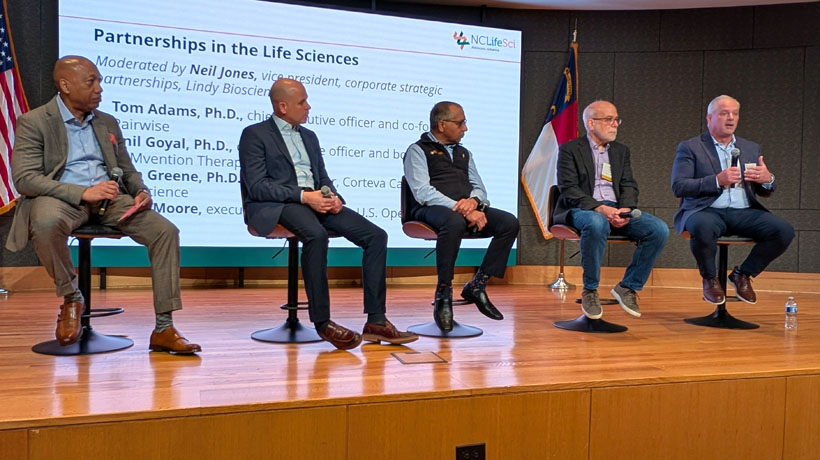
Leaders from pharmaceutical, agricultural biotechnology and drug delivery companies gathered March 5 at an NCLifeSci Life Sciences luncheon and forum at the NC Biotechnology Center for a panel discussion of what makes partnerships work — and what causes them to break down.
The panel, titled "Partnerships in the Life Sciences," drew on experience spanning major pharma deals, agricultural genome editing collaborations and drug formulation licensing agreements. Moderated by Neil Jones, vice president of corporate strategic partnerships at Lindy Biosciences, the discussion featured:
- Tom Adams, Ph.D., chief executive officer and co-founder, Pairwise;
- Anil Goyal, Ph.D., chief executive officer and board director, IMMvention Therapeutix;
- Tom Greene, Ph.D., senior director, Corteva Catalyst, Corteva Agriscience; and
- Dave Moore, executive vice president, U.S. Operations, Novo Nordisk.
The event was sponsored by Egnyte, NuShammah Pharmaceuticals, SciSure, Smith Anderson, Safety Partners (part of Trinity Consultants) and VWR, part of Avantor.
Strategy first, partnerships second
A recurring theme across all four panelists was the importance of building a partnership strategy before seeking partners. Goyal described how IMMvention Therapeutix approached Novo Nordisk not by chance, but by design.
"It's not just venture. It's going to be with partnerships, with the right partnerships that take us to the next level," Goyal said. "A small company needs to think about that from the very beginning and execute on that effectively, consistently."
Moore, who oversees more than 100 transactions per year at Novo Nordisk, said the company's commitment to a disease area drives its external innovation strategy.
"When we're committed to a disease, we're committed to it," Moore said. "We're committed to our internal R&D, but then also external innovation."
Adams, whose company uses CRISPR gene editing to develop new crop varieties, said Pairwise built partnership into its mission statement from the start.
"Understanding what each party is bringing and why you're together is really important," Adams said.
How the partnerships came together
Goyal said IMMvention's connection with Novo Nordisk began through a board member who met a Novo representative at the Bio Europe conference in 2023, leading to a follow-up meeting at the American Society of Hematology conference in San Diego.
Moore said the fit was immediately clear when his team reviewed IMMvention's work on sickle cell disease, a condition Novo Nordisk had already committed to through its rare disease business unit.
"There was no question this was a perfect fit," Moore said. "And I think once your team met with our team in Cambridge, there was a real high level of interest."
For the Pairwise-Corteva partnership, Adams and Greene said the agricultural biotechnology community is small enough that companies often know each other well before deals are formally pursued.
Greene said Corteva Catalyst — a branded platform Corteva created to manage external innovation — was established specifically to engage with startups in ways a large corporate structure cannot.
"We set this up with a bit of a mission in mind," Greene said. "It was really about accessing technology, accelerating technology, engaging with companies and technologies that were strategic to us as an organization."
Greene said he found in Pairwise a company with a similar mindset and deep expertise in genome editing.
"When we looked at pairwise, there was no doubt the stepping into a relationship with them gained us years, gave us capacity, gained us additional expertise," he said.
Why partner instead of going it alone
Goyal said IMMvention's decision to partner with Novo Nordisk rather than continue independently came down to access and resources.
"We don't have the resources, we don't have the right set of investors, and we don't have the experience of commercialization across the globe," Goyal said. "So it's all about access to the market, and partners like Novo Nordisk have that enormous infrastructure."
Goyal also noted that partnerships send a signal to the broader investment community. He said the validation of having a major pharma partner raises valuations and opens doors to additional funding.
Moore said Novo Nordisk chose to partner with IMMvention rather than acquire the company because the partnership preserved the innovation culture that made the asset attractive in the first place.
"It wouldn't make sense for us to go and acquire the company, because we would mess it up," Moore said. "We need to make sure that the experts are still around and working with us and teaching us."
Trust, transparency and governance
Jones asked each panelist about the "honeymoon hiccups" — the friction that emerges after a partnership is signed and the real work begins.
Goyal said Novo Nordisk went through significant internal changes after the IMMvention deal closed, including management turnover.
"We have to give them space so we can manage through the relationship," Goyal said. "It was really tough for Novo to go through that much change, and that's what you have to manage."
He said formal governance structures — weekly team calls, monthly joint research committee meetings, a shared data room and a joint steering committee — gave both sides a framework to surface and resolve issues before they escalated.
"Trust was a framework," Goyal said.
Adams said similar friction arises in the Pairwise-Corteva collaboration but is best handled by keeping the focus on problem-solving rather than blame.
"If you're not blaming the other company, but you're actually trying to just solve the problem, it just continues to build on the trust we're talking about," Adams said. "It's really about getting things done, not who did it."
Greene said Corteva builds flexibility into its annual science planning process, knowing that scientific results rarely unfold exactly as anticipated.
"The test of the team is being able to work through those, be solution oriented, and work together to solve the challenge," Greene said. "Teams that are able to work together collaboratively solve it — move forward — are the teams that are going to win at the end of the day."
Managing multiple partners and IP
An audience member asked Adams and Greene how Pairwise manages working simultaneously with Corteva and its biggest competitor, Bayer Crop Science.
Adams said clear contract language, physical separation of plant materials and regular training for all employees involved are key safeguards.
"As long as you plan for it, it's worked pretty well," Adams said.
Greene said exclusivity on areas of strategic importance was a central part of the negotiations with Pairwise, though he acknowledged Corteva also invests in startups where other major players are on the cap table.
"We have to be able to work with startups where other strategics may be involved as well," Greene said.
Advice for emerging companies
Jones closed the discussion by asking each panelist for a takeaway message for emerging companies seeking partnerships.
Greene emphasized engagement and clarity of purpose.
"You need strong communication. You need clarity of direction on where you want the collaboration to go," Greene said. "That engagement on strategic direction, that engagement on how do you solve problems — that's fundamental for a collaboration to work."
Adams said companies should spend time helping prospective partners understand the value of partnerships in the first place, particularly in agriculture, where the culture differs from pharma.
"It's almost like trying to get a venture investor to get some of these partnerships," Adams said.
Goyal said resilience is the most important quality for any emerging company in a long negotiation.
"Build the resilience in your entire strategy, because it'll take time," Goyal said. "We had to go down to one employee in 2024 while we were in deal negotiations. We had to lay off everybody else and have the resilience from the board, from the team, to say, this deal will happen."
Moore told the audience to find an advocate inside the prospective partner organization and to know clearly what they want from a deal.
"Find an internal champion," Moore said. "And know what you want. It's your company. So it's important to know what a good deal is for you and what you're looking for."