
Panelists navigate the complex terrain of agricultural regulatory strategy at NCLifeSci agtech forum
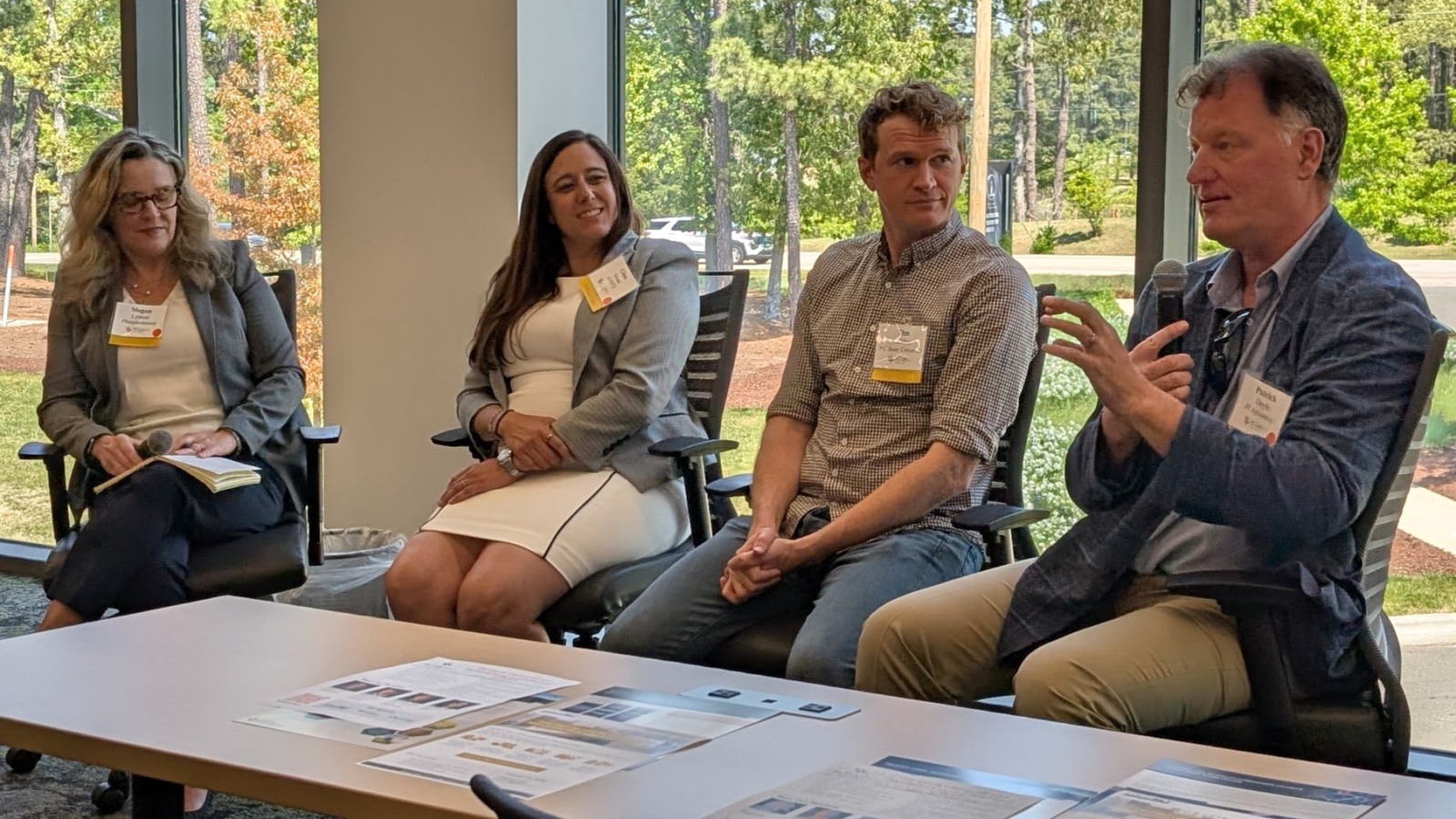
Megan Lyman, Gina Sloan, Tim Kelliher and Patrick Doyle comprised the panel at the 2026 NCLifeSci Agtech Luncheon and Forum.
The NC Life Sciences Organization brought together four agricultural technology leaders on April 15 for its Life Sciences Luncheon and Forum at the Alexandria Center for AgTech in Research Triangle Park.
The event, hosted with the support of Alexandria Venture Investments, drew an audience of investors, entrepreneurs and industry professionals for a wide-ranging panel discussion on the regulatory challenges facing companies in crop science, animal health and biologic fertilizers.
The panel, moderated by Megan Lyman, general counsel at Phospholutions, featured:
-
Patrick Doyle, Ph.D., lead, regulatory affairs for North America and global biologicals, PI AgSciences;
-
Tim Kelliher, Ph.D., director, Genome Editing Center for Sustainable Agriculture, NC State University; and
-
Gina Sloan, Ph.D., chief executive officer and founder, AGRITX.
NCLifeSci thanks its event sponsors: EquipNet, Smith Anderson and VWR, part of Avantor.
Navigating the agricultural regulatory landscape
The panelists opened by describing the regulatory environments specific to their sectors — a landscape that Doyle characterized as fragmented and fast-moving.
"Innovation is always well ahead of regulations, which makes sense because regulations are based on established precedents," Doyle said. "And policy is always well ahead of regulations too."
Doyle, who works primarily with the EPA on biopesticide submissions, described his approach as relationship driven. Presubmission consultation meetings are essential, he said, as is building credibility with senior agency decision-makers over time.
"It's a glorified sales pitch. You want to establish credibility, and you want common labels that make sense," Doyle said. "If you make a promise with the regulators, you deliver."
Kelliher offered a perspective shaped by 13 years in industry at Syngenta before his move to academia. He focused on a significant shift in the regulatory treatment of gene-edited crops, particularly in Europe, where CRISPR-based modifications have historically been classified as GMOs — a designation that carries a price tag of $30 million to $50 million for global deregulation. That is changing.
"It's now looking like 95% probability that Europe is going to adopt very similar policies to what the US has been leading the way, with Brazil, Argentina and the UK and other countries adopting similar frameworks," Kelliher said, "Treating gene-edited crops as completely different from GMOs with the main dividing line being: do you have foreign DNA inserted into the crop?"
For crops developed without foreign DNA, the regulatory path in the U.S. is already fast. Kelliher said that a USDA review of a CRISPR-based gene edit "can get a reply within a couple months maybe, and very minimal data requirements" — a sharp contrast to the four-to-eight years required for a GMO through a full global deregulation process.
Sloan described a different set of challenges in the animal health sector, where the same product can fall under the jurisdiction of the EPA, FDA or USDA depending solely on the claim made on the label and the route of delivery. Her company, AGRITX, has taken a nutritional approach that allows it to enter the market using existing registrations while working with regulators to define new pathways for novel ingredients.
"Timeframe is more on that five-to-ten-year march," Sloan said. "Changing regulations is not easy. Defining a new regulation is not easy. And it is much of a collaboration with the senior level regulators."
Lyman spoke to the challenge facing Phospholutions, which has developed the first significant innovation in phosphorus fertilizer technology in roughly 60 years. Entering a commodity-based regulatory system with a genuinely new technology created friction at multiple levels.
IP strategy, trade secrets and the cost of transparency
A significant portion of the discussion turned to intellectual property, particularly the tension between protecting proprietary methods and the transparency regulators require. Sloan described a nine-year process her prior company undertook to register a new class of disinfectant the EPA had never seen before. The lengthy engagement ultimately produced an unexpected competitive advantage: under the new protocol development process, the EPA was prohibited from disclosing the protocol to competitors until the product reached store shelves.
"It allowed us around a three-year march to be the only people in market," Sloan said. "You couldn't have fast followers."
Doyle reinforced the risks of trying to shield too much from regulators.
"If you don't tell them, they're going to find out down the road, and it's going to cost you time and money," he said. "There are completeness checks all over the place. You have to have that investment."
The panel agreed that getting executive teams to accept the level of disclosure regulators require is often a challenge in itself. Sloan's approach is direct.
"Resistance is futile," she said. "You might not like it, you might not agree with it, you might not even know the logic behind it. But in the end, you have to do what is asked of you. There is no other option if you want to sell something into market."
Resource constraints and the value of outside expertise
The discussion of big-company versus small-company realities drew candid observations from all four panelists. Sloan, who leads a five-person startup after years at a global corporation, was clear about what small companies should not try to do alone.
"There are people who have spent their careers getting to know the regulators that you need to know. You do not need to reinvent that wheel," Sloan said. "You need to find that person."
Doyle described a philosophy of strict internal prioritization under resource constraints, pushing back on business teams to produce a clear business case before any regulatory work begins. For external support, he invests deliberately in relationships with top consultants.
"You find a good consultant, treat them like gold," Doyle said.
Kelliher noted that NC State's gene editing center has relied heavily on a single regulatory consultant with deep relationships in the field — someone who not only knows the processes but can write the dossiers and navigate international markets.
The role of AI and North Carolina's support network
The final exchanges touched on artificial intelligence and on the value of North Carolina's life sciences support infrastructure. Panelists agreed that AI holds real promise for speeding up regulatory work — building clearer dossiers, synthesizing data across multiple regulatory frameworks — but emphasized the need for human oversight.
"We use AI to help us dig through data, but it's always with a human backdrop," Sloan said. "It's still hallucinating, because it's still a thing."
Doyle noted that the EPA itself is investing in AI to improve internal processes, particularly for repeatable review tasks.
All four panelists singled out the North Carolina Biotechnology Center as a meaningful resource in their work — both for direct support and for the connections it has helped facilitate.
"North Carolina has a very good allied industry that supports startups, helps us find our way and navigate our way," Sloan said. "It's a really good place to start. We've been through a few other Ag states, and it just doesn't feel as if you have that same infrastructure build as you do here."
Doyle, who noted he has no intention of leaving the state despite his company's headquarters moving to St. Louis, put it plainly.
"This is North Carolina. I'm never leaving," he said. "I have all my connections here, and it's world class."