
Forum: Real estate, infrastructure and talent define North Carolina's life sciences growth story
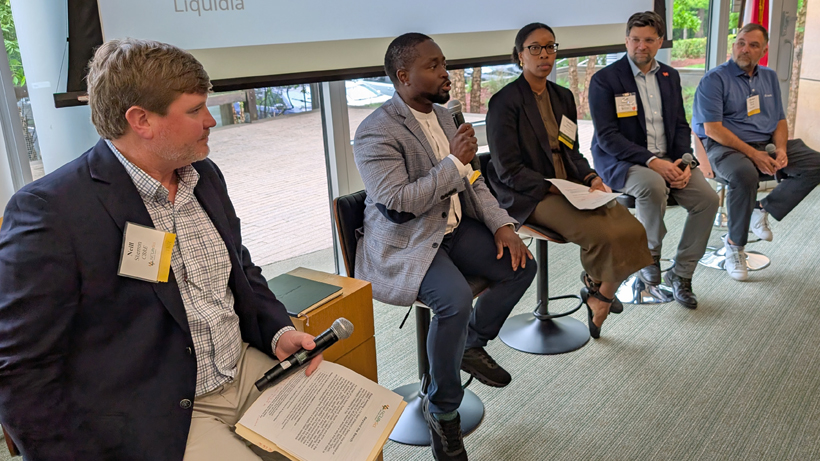
Supply chain resilience, facility design and regional collaboration took center stage at the NCLifeSci Life Sciences Luncheon and Forum on July 23 at the NC Biotechnology Center.
Neill Sherron, senior vice president at CBRE, moderated a panel of industry, real estate and economic development leaders examining how North Carolina's physical infrastructure and ecosystem are keeping pace with the state's rapid life sciences expansion.
Panelists were
-
Lindsey Brown, director of design and construction at Longfellow Real Estate Partners;
-
Jason Davis, Ph.D., director of business development at GXP Storage;
-
Matt Gladdek, vice president of economic development at the Greater Durham Chamber of Commerce; and
-
Michael Hunter, senior vice president of manufacturing operations at Liquidia.
The event was sponsored by ALT (American Laboratory Trading), HIPP Design + Consulting, Longfellow Real Estate Partners, Safety Partners (a Trinity Consultants team) and VWR, part of Avantor.
Supply chain pressures on construction and talent
Brown said the scale of recent investment in North Carolina, from large pharmaceutical manufacturing facilities to data centers, is straining two resources simultaneously: construction materials and skilled trades workers.
"We're seeing lead times for steel starting to expand," she said. "We're seeing electrical gear prices go up. It's very difficult to get product."
She said the harder problem is competition for trades workers. Large pharmaceutical and data center projects are drawing from the same pool of electricians, ironworkers and construction specialists the region needs to build the next wave of life sciences facilities.
"The RTP really needs to be thoughtful about attracting talent and keeping talent," Brown said of the trades. "I think that's going to be the hardest resource for us to continue to stay ahead of."
Laura Rowley, Ph.D., vice president of life sciences economic development at the NC Biotechnology Center, reinforced that point. Companies entering site-selection conversations express confidence in North Carolina's ability to staff facilities once they are built, she said, but raise questions about whether the skilled trades workforce is large enough to build them in the first place, given how many major projects are competing for the same labor simultaneously.
"If you can build it, we know that North Carolina is going to be there to staff it," Rowley said. "But do you have the skilled trades?"
Designing for compliance, redundancy and growth
Sherron asked Hunter and Brown to describe what life sciences companies are now prioritizing when they design and build facilities.
Hunter said compliance cannot be retrofitted into a building. It has to be designed in from the first conversation with architects and general contractors, all the way through to the subcontractors delivering turnover packages.
"You have to do it with intent," he said. "You have to do it with the purpose of getting quality right out of the gate."
He said Liquidia's approach to every expansion, including the company's new 71,000-square-foot facility in Morrisville now under construction, has centered on three priorities: no single point of failure in building infrastructure, room to grow under the same roof or in adjacent space, and proximity between sites so teams across facilities can collaborate.
Brown said that Longfellow's primary competitive advantage is the ability to compress time to market by building out high-specification space ahead of tenant demand, a strategy that requires anticipating how fast the technology is changing.
"We are building out in anticipation of our tenants, which is tricky because the technology is changing rapidly," she said.
Brown said she is seeing a shift in what tenants ask about first. Floor-to-floor height, not a question developers typically heard a few years ago, has become one of the most common early inquiries, a signal that tenants are bringing in larger and more complex equipment including robotics and advanced manufacturing systems. Vibration arresting has become a standard requirement for many spaces. Power runs through all of it.
"The word of the day is power," she said. "Everybody wants power. They want more power. They want scalable power. They want uninterrupted power."
Hunter said the evolution of the developer side of the market has been equally significant. When Liquidia started, most available space was office building conversions with no consideration for material flow, power requirements or ceiling height. The shift to developers who build with life sciences tenants specifically in mind has changed what smaller companies can access without a custom ground-up build.
He also pointed to growth in commissioning, qualification and validation companies and in owner's representative and program management firms that now specialize in the life sciences qualification process, an area where expertise was once rare outside of the large companies that could develop it internally.
Purpose-built storage as supply chain infrastructure
Sherron turned to Davis to describe how GXP Storage's Nash County facility addresses risk and compliance for pharmaceutical companies managing materials across multiple sites and programs.
Davis said the complexity of pharmaceutical storage tends to become visible only after it has already become a problem. As programs grow, the number of materials and the compliance requirements around them multiply in ways that site-specific storage cannot manage at scale.
GXP Storage provides validated temperature environments spanning the full range (controlled ambient, refrigerated, minus-20, minus-40 and cryogenic) along with a 21 CFR Part 11-compliant platform that integrates quality management, material management and environmental monitoring systems.
"There is more to storage than just a physical aspect, not just another footprint in the building," Davis said. "There are multiple layers of complexity that have been brewing over the surface over time."
Hunter made the connection to how offsite, purpose-built storage fits into the broader facility strategy. Companies that are space-constrained or managing cold chain risk under a single roof now have the option to place those materials with a vendor that specializes in validated storage, gaining compliance redundancy without building it themselves.
Regional collaboration and economic development
Durham has recorded $2 billion in capital investment and 2,000 new jobs since November 2025, Gladdek said, citing those figures as evidence of what regional collaboration produces. He described a model in which the NC Biotechnology Center, the Economic Development Partnership of North Carolina, county economic development offices and NCLifeSci present together to prospective companies, openly, in the same room.
"We're always saying we want you in RTP first, North Carolina second. Well, it's our county first, really," he said. "But it's mostly about the collaboration."
Gladdek gave two recent examples. When competing for Novartis, Durham's permitting timeline was slower than Texas (four months compared to three) but the depth of the workforce ecosystem made the difference. For AbbVie, a set of transmission lines crossing the target site threatened to end the project until Duke Energy committed to relocating them at hurricane-response speed.
North Carolina's incentive structure is milestone-based, Gladdek said, meaning companies receive payments only after delivering on job and investment commitments. The state rarely deals with clawbacks and offers incentives as a fraction of what competing states put on the table, because the ecosystem justifies it.
"Had we not offered incentives, we wouldn't have gotten the project," he said. "Taxpayers are always positive in how we run our incentives."
Infrastructure now rivals workforce as the top site-selection factor
Rowley said the nature of site-selection conversations has shifted over her decade in economic development. For most of that time, workforce was the dominant concern. Now infrastructure leads.
"It was workforce all day, every day for the first eight to nine of those years, and now it is all about infrastructure," Rowley said. "I can't tell you how many deals we are getting not because of Duke University, but because of Duke Energy. They need to be at the table."
Gladdek said water and sewer capacity will be a constraint for years. Durham is working to accelerate investments in pump stations and expand water supply by tapping Jordan Lake. He said RTP benefits from transmission line infrastructure put in place when the park was founded, giving the region natural power redundancy that newer markets cannot easily replicate.
She said the state's manufacturing workforce investment leans heavily toward biomanufacturing, with community college programs expanding across multiple campuses to meet the hiring needs of companies including Novartis and AbbVie. Workforce development for highly specialized roles is harder to plan for at scale.
Hunter said the community college system's role has become central to sustaining a manufacturing workforce. The growth of GMP manufacturing in the region means employees coming out of programs at BioNetwork and similar institutions now enter workplaces where they accumulate practical experience that further builds the regional talent base.
"You now have a workforce that's not only getting trained coming out of school, but you have opportunity for those people to have been exposed in larger companies," he said. "It creates a sustaining workforce."
Brown singled out Wake Tech specifically for its responsiveness to industry needs, reaching out proactively to large pharma companies to ask what skills will be needed and building programs around those answers.
Gladdek noted that Durham County passed a $122 million bond that is funding a life science training center and a health science training center, with structural steel already up. North Carolina's incentive structure also directs a significant portion of funds to customized community college training, ensuring that workforce development is built into the terms of landing major employers.
Nearshoring and the personalized medicine question
Gladdek said the wave of nearshoring and onshoring investment flowing into North Carolina reflects decisions companies were already planning before federal pressure accelerated the timeline.
"The pandemic didn't really change things; it just sped things up," he said. "A lot of foreign companies realized they needed to diversify where they're making their drugs."
He said loss of federal research funding to North Carolina universities is a concern that will require new strategies, including external research partnerships with Duke, N.C. State and UNC, to maintain the pipeline of innovation that generates the next generation of life sciences companies.
Ashton Poole, a partner at QHP Capital, a private equity firm that invests in outsourced service companies supporting the pharmaceutical ecosystem, raised the question of how personalized medicine and smaller batch sizes will reshape manufacturing facility design and the services ecosystem around it. As batch sizes shrink and changeout frequency increases, single-use components generate more waste, and the compliance and logistics requirements around that waste become more complex.
Brown said the gene therapy segment is already operating in that model, with small batch runs that will never scale like large pharmaceutical manufacturing and that are often caught off guard by waste management requirements.
"They get distracted by the technology, but my group has to say, 'What are you going to do with the waste?'" she said. "It would be very beneficial to this ecosystem if somebody helped them with that."
Sherron noted that the location of small-scale manufacturing is becoming a strategic question in its own right, with some groups pursuing hyper-local facilities on hospital campuses to place manufacturing as close to the patient as possible.
He said loss of federal research funding to North Carolina universities is a concern that will require new strategies — including external research partnerships with Duke, N.C. State and UNC — to maintain the pipeline of innovation that generates the next generation of life sciences companies.
Ashton Poole, a partner at QHP Capital, a private equity firm that invests in outsourced service companies supporting the pharmaceutical ecosystem, raised the question of how personalized medicine and smaller batch sizes will reshape manufacturing facility design and the services ecosystem around it. As batch sizes shrink and changeout frequency increases, single-use components generate more waste, and the compliance and logistics requirements around that waste become more complex.
Brown said the gene therapy segment is already operating in that model — small batch runs that will never scale like large pharmaceutical manufacturing and that are often caught off guard by waste management requirements.
"They get distracted by the technology, but my group has to say, 'What are you going to do with the waste?'" she said. "It would be very beneficial to this ecosystem if somebody helped them with that."
Sherron noted that the location of small-scale manufacturing is becoming a strategic question in its own right, with some groups pursuing hyper-local facilities on hospital campuses to place manufacturing as close to the patient as possible.