
Workforce hiring data drives discussion at Q3 BMF meeting
The NC Life Sciences Organization's Biotech Manufacturers Forum met Sept. 23 for its third-quarter session, bringing together site leaders, human resources teams and academic partners to examine a question raised at the group's August site leadership dinner: Does North Carolina have enough biomanufacturing workforce to meet demand, and where are the gaps?
Bill Monteith, NCLifeSci's program manager for the forum, opened the workforce session by pointing to the format itself as a differentiator for North Carolina. While speaking on a panel at the International BIO Conference in June, he had representatives from Georgia, Oregon, Texas, Massachusetts and Maryland ask how North Carolina gets industry and academic partners to sit at the same table on workforce planning. No other state represented on the panel reported doing this routinely, he said.
Life sciences growth outpaces some expectations
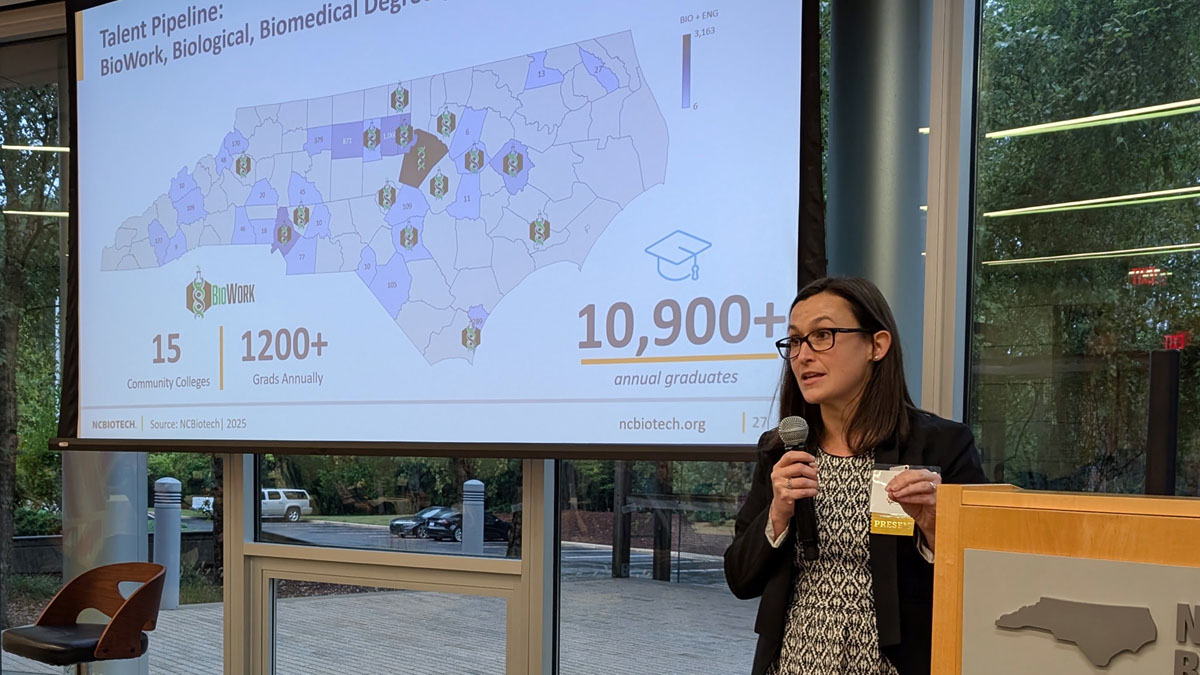
Laura Rowley, Ph.D., vice president for life sciences economic development at NCBiotech, opened the forum with data on the scale of the state's life sciences sector. North Carolina is home to 860 life sciences companies employing 76,000 people directly, plus 2,500 support companies in fields such as architecture, engineering, construction and intellectual property law. Manufacturing and production sites account for about half the industry's total workforce despite making up a smaller share of company locations overall.
Rowley noted the growth is not a recent development. Manufacturing employment grew 26% in the second half of the 2010s alone. Life sciences manufacturing employment in North Carolina now stands at more than 34,800 people, up from zero in 1974.
Recent expansion announcements show existing companies reinvesting alongside new entrants establishing their first North Carolina sites. Biogen continues to add to its long-standing presence, while newer arrivals including Johnson & Johnson and Genentech have expanded after initial projects in the state. Novartis' expansion adds small molecule manufacturing to a market that has trained primarily for biologic drug substance work, and companies statewide report growing demand for drug product training as more sites take on syringe and device assembly work. Growth also continues to extend beyond the Triangle, with investment reaching eastern North Carolina through the BEST Center, East Carolina University and regional pharma training networks.
Rowley also outlined why supply looks favorable on paper. North Carolina's population has reached 11.2 million people, with a labor force of 5.3 million. The state ranks ninth in population nationally, adds about 358 residents a day and ranks first in the nation in domestic net migration. In Durham County, the average age of newcomers is 27, and 59% of residents 25 and older hold a bachelor's degree or higher, compared with a national average of about 38%.
The state's training pipeline includes 15 community colleges offering the BioWork certificate program, graduating about 1,200 students a year with a 55% placement rate in life sciences roles. Enrollment in BioWork has grown 60% since 2020, with six new schools adding the program in that span. Combined with roughly 10,900 annual graduates in biological, biomedical and engineering degree programs statewide, Rowley estimated the state produces about 12,000 potential life sciences hires a year.
Weighing that supply against demand, Rowley calculated that companies have announced 10,600 new jobs since 2022, of which roughly 2,600 are already filled. That leaves about 8,000 jobs to fill over a typical five-year hiring horizon, or roughly 1,600 jobs a year, a figure Rowley said the state's training pipeline is positioned to support, though not every graduate is ready for every posted role.
Rowley also highlighted the MOVE Boots to Biotech military outreach program, which has produced 41 on-the-job internships, 105 training internships and 45 direct job placements since 2023 for transitioning service members. North Carolina hosts one of the country's largest military installations at Fort Bragg and about 20,000 service members transitioning out of the military from North Carolina sites each year. Community colleges statewide have also drawn more than $230 million in announced investment for new and upgraded training facilities since 2024.
Survey points to hiring and retention pressure points
Christie Weaver, senior director of the BioNetwork Capstone Center, presented results from a hiring pulse survey of 21 site heads and HR and talent acquisition leaders. About 65% of respondents described hiring as somewhat difficult overall, and local talent within a one-hour commute proved harder to attract than out-of-state talent for many respondents.
Mid-career roles ranked as the hardest to hire, followed by early-career roles, senior leadership and entry-level positions. By functional area, engineering roles topped the list of hiring challenges, followed by quality and regulatory positions and manufacturing operations. Within engineering specifically, 57% of respondents named automation engineers as their hardest position to fill.
On retention, early-career employees proved hardest to keep, with respondents citing limited career growth opportunities, competition for higher salaries and cultural fit as the leading causes of turnover in the three-to-five-year range. Engineering again ranked as the functional area hardest to retain. Nearly three-quarters of respondents, 74%, said specific skills are missing or limited in the North Carolina market, naming automation and control systems, mechanical skills, one to two years of drug substance experience, and critical thinking and communication as gaps.
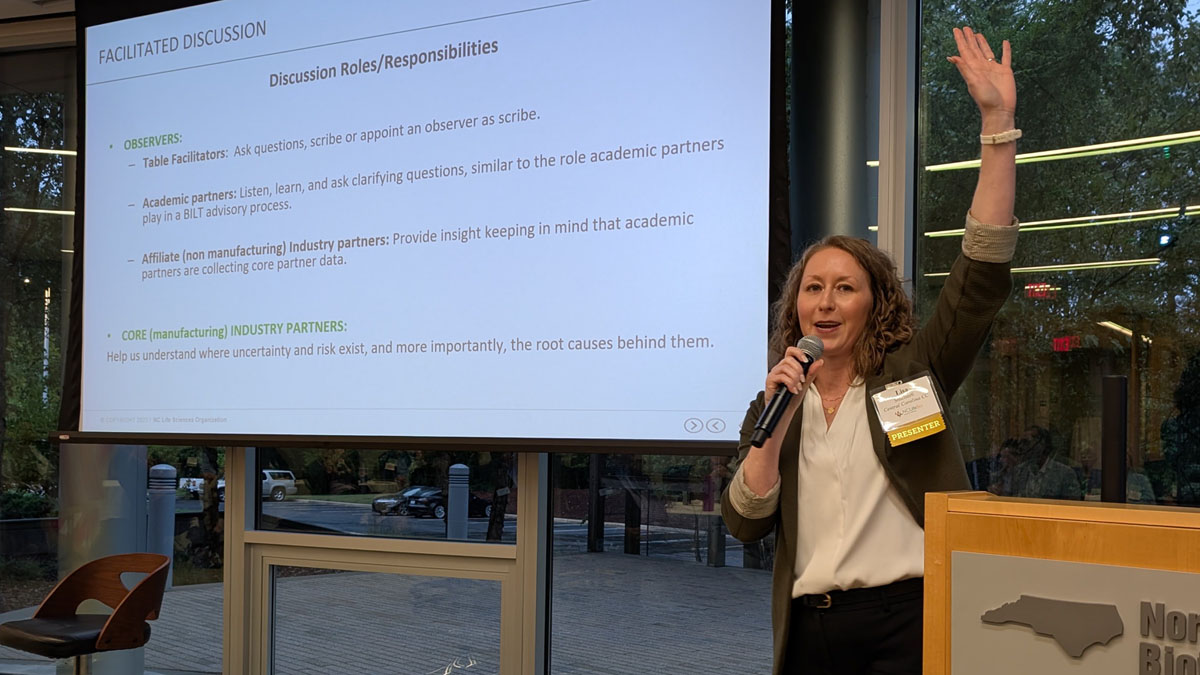
Lisa Smelser, executive director of workforce strategic initiatives at Central Carolina Community College, then led table discussions built around two questions: what would increase confidence in the workforce pipeline, and what would decrease hiring risk. Industry representatives led the discussion while academic and affiliate partners listened and asked clarifying questions, with a goal of identifying the root causes behind hiring uncertainty rather than the uncertainty itself.
Workforce programs update members
Several guest speakers gave brief updates on workforce initiatives during the meeting:
Hadassah Eley of CME Strategies described her firm's work helping manufacturers with organizational development, including leadership upskilling and root cause analysis training.
Brenda Grubb, Ph.D., of Central Carolina Community College outlined the college's BILT model, a four-step process (identify, prioritize, crosswalk, train) that brings industry partners directly into curriculum design. The model produced a new quality control certificate developed from industry-identified trends, and the college's apprenticeship partnership with Pfizer has placed multiple student interns into full-time roles.
Stephanie Winstead of the BEST Center of Eastern North Carolina reported $65 million in combined funding for the center's Wilson facility, including $30 million from the North Carolina General Assembly for construction, $13 million from Golden Leaf for equipment, $10 million for operations and an additional $12 million after Johnson & Johnson selected Wilson for a drug product facility. The base drug substance facility is on track for completion by mid-February 2027, with the drug product expansion following by mid-August 2027. The expanded center will offer training spanning isolator work, cap and seal, visual inspection, and labeling and packaging.
Leslie Isenhour and Al Brewer of Wake Technical Community College presented the college's BioMechatronics apprenticeship program, which the college describes as the first of its kind nationally. The 584-hour program combines biotechnology fundamentals with mechatronics training in electrical systems, motor controls, pneumatics and mechanical power systems, aimed at addressing an aging maintenance technician workforce. The first cohort included employees from Eli Lilly, CSL Seqirus and Fujifilm Biotechnologies; a second cohort now underway includes CSL Seqirus and Merck.
Legislative and organizational updates
Laura Gunter, NCLifeSci's president, gave a briefing on state and federal legislative activity. At the state level, the General Assembly's Life Sciences Caucus introduced an omnibus appropriations bill this session, and the final budget included increased NCBiotech funding, reauthorization of the Rare Disease Advisory Council under the Department of Health and Human Services, and a water and wastewater bill benefiting larger manufacturers. North Carolina chose not to adopt a federal fix for research and development expensing rules, creating new tax exposure for pre-revenue, grant-funded companies. Gunter noted that neither chamber of the General Assembly is expected to hold a supermajority after the November election, which historically has pushed legislators toward bipartisan compromise.
At the federal level, Gunter flagged continued "most favored nation" pricing settlements between the administration and pharmaceutical companies, pending GUARD and GLOBE payment models, and a proposed Office of Management and Budget rule that would add political review to federally funded grant decisions. A congressional continuing resolution delayed that rule's implementation through Dec. 11. The Department of Commerce also released new tariff notices under Section 232 that NCLifeSci continues to review for industry impact.
Monteith previewed the forum's 2027 topic calendar: power reliability March 16, childcare June 29, a site leadership dinner Aug. 24, retention and workforce volume (part two) Sept. 21, and wastewater Dec. 7. The Q4 2026 meeting, set for Nov. 3, will focus on regulatory benchmarking with an emphasis on artificial intelligence compliance trends. Active discussion groups include a digital manufacturing group restarting in person with Merck, a sustainability group and a new roundtable on facility buildout challenges organized with Implement Consulting Group.
Jenae Williams, NCLifeSci's director of workforce and partnerships, also promoted the NCBioImpact Network, a 22-member collaborative of educational, economic and workforce development partners marking its 25th year, and the NCLifeSci DEI Committee's Nov. 13 event, "Beyond the Backlash: Charting the Next Wave of Inclusion," at the NCBiotech Center. The event will feature keynote speaker and moderator Gracie Johnson-Lopez, a panel discussion and a reception. Pfizer and Merck have sponsored the event, and the committee is seeking additional sponsors and panelists.
Members in attendance
Company members represented at the meeting, according to the meeting agenda, included A-Bio, Astellas Gene Therapies, BE&K Building Group, Biogen, Eli Lilly and Company, Genentech, Implement Consulting Group, IPS, Johnson & Johnson, KBI Biopharma, Kyowa Kirin, Liquidia, Novo Nordisk and Novonesis. Christman Company, Frontier Scientific Solutions and Novartis attended as courtesy guests.
Workforce partners included Central Carolina Community College, Durham Technical Community College, NC A&T State University, NC Central University, NC State University's BTEC program, NCBiotech, NCBioNetwork, NIIMBL, Wake Technical Community College and Wilson Community College's BEST Center.
Next up for the forum is the Q4 2026 meeting Nov. 3 on regulatory benchmarking.